
DC Fast Charging: The Ultimate Guide to How It Works
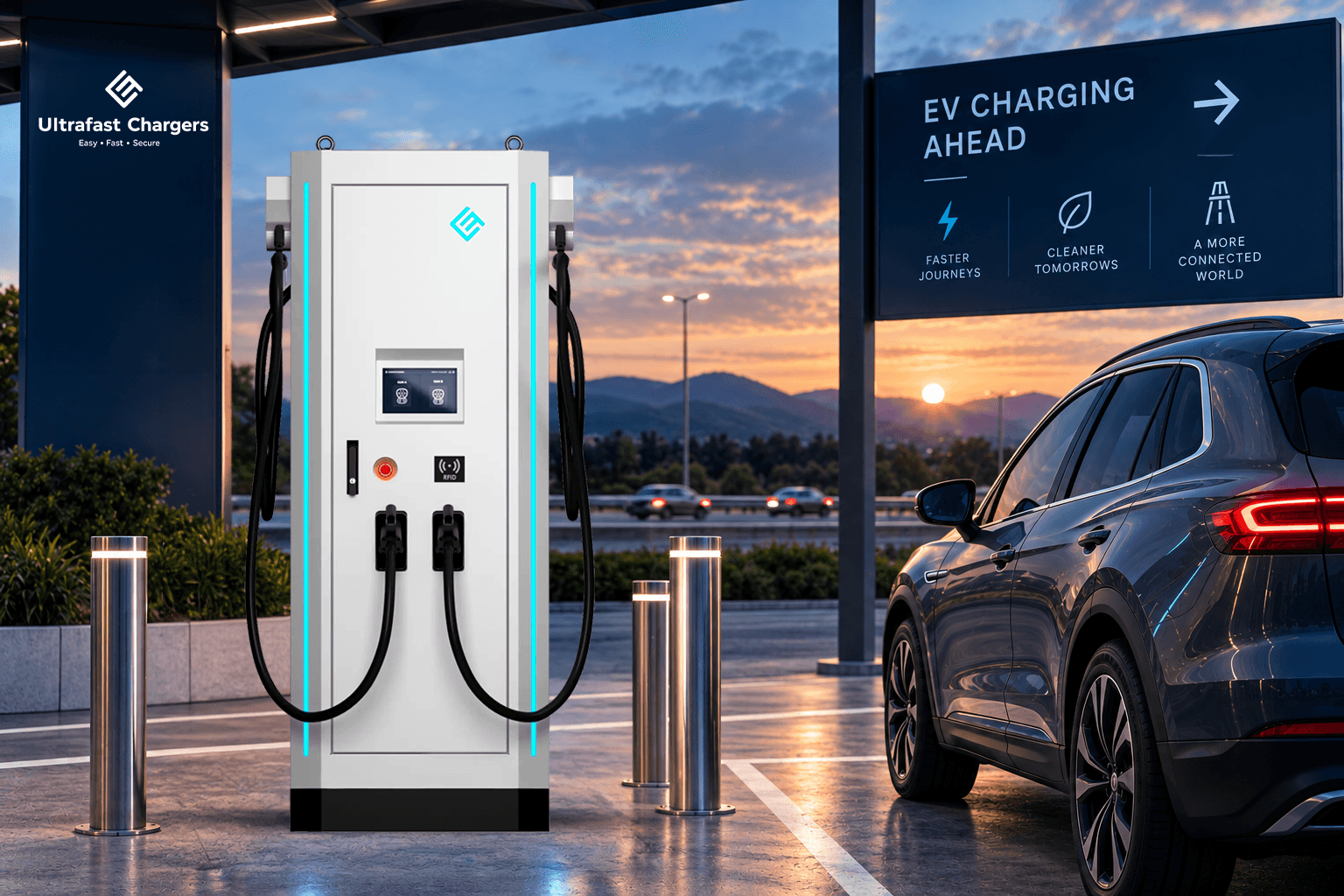
The Ultimate Guide to DC Fast Charging
DC fast charging (DCFC) is a method of EV charging where the AC-to-DC power conversion happens inside the charger itself, rather than inside the vehicle. This removes the bottleneck of the car's small onboard converter, allowing power levels from 22 kW up to 400+ kW and cutting charge times from hours to as little as 15–30 minutes for a meaningful top-up.
Key Takeaways
- DC fast charging bypasses the EV's onboard AC-to-DC converter, enabling much higher power delivery than AC charging.
- Power tiers generally break down as: 22 kW (entry/workplace), 60–240 kW (fleet/urban), 120–400 kW (highway/ultra-fast).
- CCS2, OCPP (1.6J/2.0.1), and ISO 15118 are the core standards behind virtually every modern DC fast charging session in India.
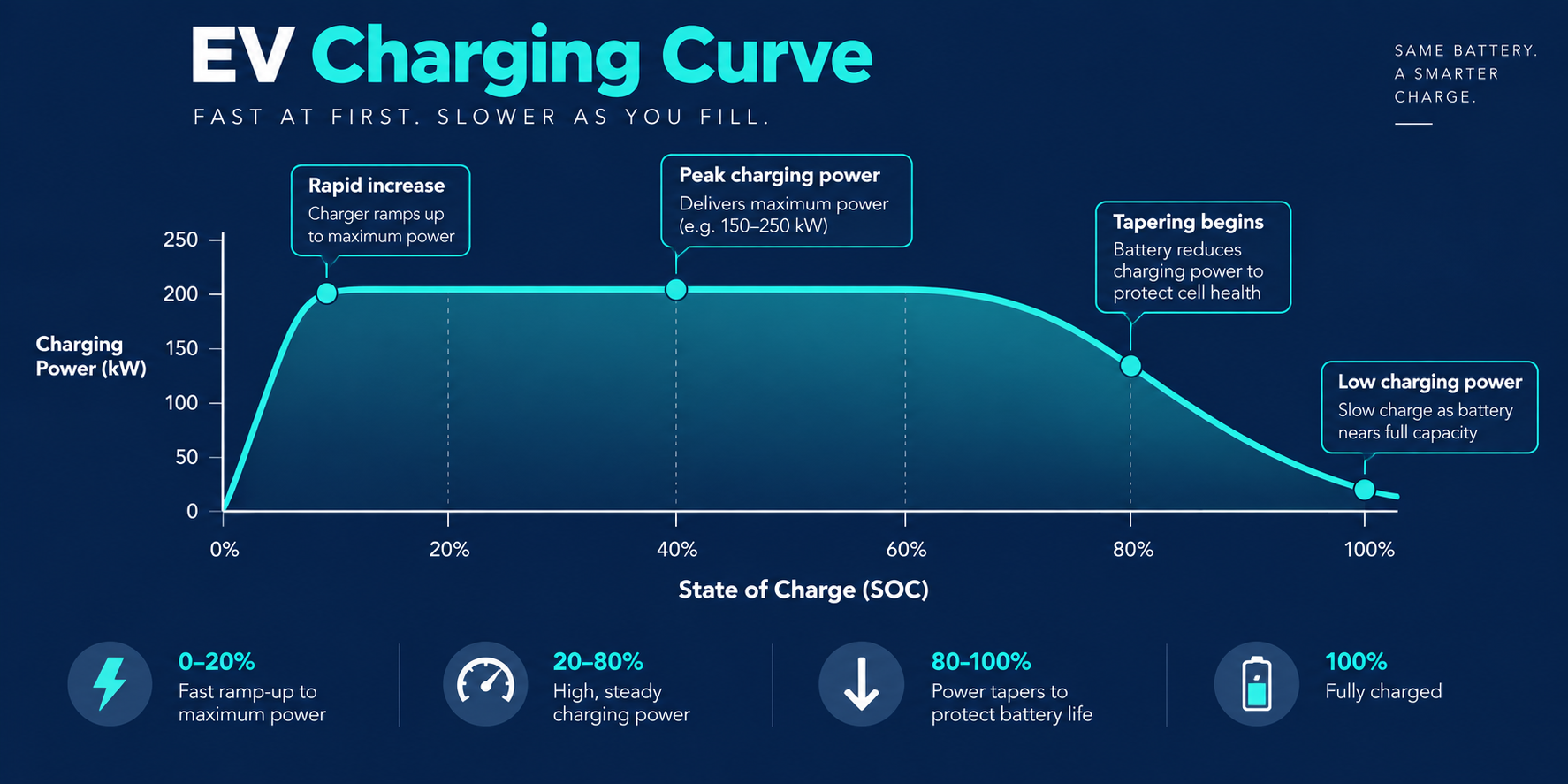
- Charging speed always follows a curve — fast from low state of charge, tapering after ~80% to protect battery health.
- UFCL's UFC 22 kW, UFC240, and UFC400 span this entire power range on one connected, ARAI-certified platform.
What Is DC Fast Charging?
DC fast charging (DCFC) is one branch of the broader topic of EV charging — it delivers direct current straight to an EV's battery, bypassing the vehicle's onboard AC-to-DC converter — the component that limits regular home and workplace charging to a slow trickle. Because the conversion happens inside the charger, DCFC units can deliver dramatically more power, letting compatible EVs add significant range in the time it takes to grab a coffee rather than overnight.
UFCL's DC fast charging portfolio spans this entire spectrum in one product family: the compact UFC 22 kW wall-mounted unit, the UFC240 scaling from 60–240 kW, and the flagship UFC400 running 120–400 kW with a 500 A boost mode.
How DC Fast Charging Works, Step by Step
- AC-to-DC conversion happens inside the charger's power modules, not the car.
- Communication and authentication — the charger identifies the vehicle and authorises the session via RFID, a mobile app, Autocharge, or ISO 15118 Plug & Charge (certificate-based, no card needed).
- The charging curve — power delivery isn't flat. It ramps up quickly, holds near peak while the battery's state of charge is low, then tapers as the battery fills to protect cell health. This is why DC fast charging is usually described as "10–80% in X minutes" rather than "0–100%."
- Dynamic load sharing (on multi-gun UFCL units like the UFC240 and UFC400) — if two vehicles are charging simultaneously, available power is allocated in real time based on what each vehicle is actually requesting, not split evenly, maximising throughput per bay.
Power Tiers, and What They're Actually For
| Power Range | Typical Use Case | UFCL Product |
|---|---|---|
| 22 kW | Workplaces, hotels, destination charging, longer dwell times | UFC 22 kW |
| 60–240 kW | Fleet depots, urban charging hubs, commercial sites | UFC240 |
| 120–400 kW | Highway corridors, high-throughput commercial sites, flagship CPO sites | UFC400 |
The Standards Behind Every DCFC Session
- CCS2 (Combined Charging System) — India's standard DC connector for four-wheelers.
- OCPP (Open Charge Point Protocol) — the open standard that lets a charger talk to a backend management system (CSMS) regardless of vendor. UFCL supports both OCPP 1.6J and 2.0.1.
- ISO 15118 — enables Plug & Charge, where a compatible vehicle authenticates automatically via digital certificate.
- ARAI certification — India-specific homologation confirming a charger meets the country's safety and performance requirements. All UFCL products are ARAI certified.
What Separates a Good DC Fast Charger from a Mediocre One
- Sustained efficiency, not just peak-spec efficiency — UFCL's range maintains >96% conversion efficiency across the full 22 kW–400 kW operating window, not just at one ideal load point.
- Thermal management — sustained high-current output generates heat; UFCL uses centrifugal cooling and a thermal-path-optimised cabinet to avoid derating during peak summer conditions.
- Connector durability — the gun and cable are the highest-cycle components on any charger. UFC400 uses replaceable gun contacts and an anti-water-logging gun holder specifically engineered for monsoon conditions.
- Remote manageability — OTA firmware updates mean security patches and new features can be pushed to an entire fleet of chargers without a truck roll.
Where DC Fast Charging Is Deployed
Fleet depots (fast turnaround between shifts), highway corridors (minimise driver downtime on long trips), urban charging hubs, commercial properties (malls, hotels, dealerships), and public CPO networks all rely on DC fast charging as the backbone of "real" EV infrastructure — AC charging alone can't support high-utilisation, time-sensitive use cases.
FAQs
What's the difference between DC fast charging and ultra-fast charging? There's no universally fixed cutoff, but "ultra-fast" generally refers to the higher end of DC charging — typically 150 kW and above — designed to minimise charge time even further. UFCL's UFC400 (120–400 kW) sits in this category. See our dedicated guide, What Is an Ultra-Fast Charger?, for the full breakdown.
Do all EVs support the maximum power a DC charger offers? No. The vehicle's own onboard architecture and BMS cap how much power it can accept, regardless of what the charger can deliver — this is why the same 240 kW charger might charge one EV at 150 kW and another at only 60 kW.
Is OCPP 2.0.1 necessary, or is 1.6J enough? 1.6J covers solid remote monitoring, OTA updates and basic session management. 2.0.1 adds TLS security, advanced smart-charging profiles, ISO 15118 Plug & Charge, and V2G readiness — worth it for operators planning to scale or integrate with smart-grid programmes.
How fast is DC fast charging compared to a petrol fill-up? It's closing the gap but isn't identical yet: a fuel fill-up takes roughly 3–5 minutes, while today's fastest DC ultra-fast chargers (150–400 kW) typically need 15–30 minutes for a meaningful top-up — comparable to a quick highway break rather than an instant stop.
What is a charging curve, and why does it matter? A charging curve plots how much power a battery accepts over time during a session. It starts high, holds near peak while the battery is low, then tapers noticeably past roughly 80% state of charge — which is why DC fast charging is always described as "10–80% in X minutes," not "0–100%."
Can two vehicles charge at once on a dual-outlet DC fast charger? Yes, on chargers with dynamic load sharing (like UFCL's UFC240 and UFC400) — available power is allocated between both vehicles in real time based on what each is actually requesting, not split evenly by default.
What happens if the grid connection at a site can't support a high-power DC charger? The charger's rated power is capped by the site's actual electrical supply; this is why a site survey and single-line drawing assessment should always precede equipment selection for any DC fast-charging deployment.
Is DC fast charging available for two-wheelers and three-wheelers in India? Some models support DC fast charging via Light EV DC standards (up to ~12 kW), but many two- and three-wheelers in India still rely on lower-power AC charging standards like Bharat AC-001.
UFCL's Take
Whether you're speccing a single 22 kW unit for a hotel or a multi-bay 400 kW highway hub, DC fast charging is a systems decision — power electronics, thermal design, connectors, and software all have to work together. See the full UFC range or book a free site survey.