
DC Fast Charger Cost in India: Full Price Breakdown
How Much Does a DC Fast Charger Cost?
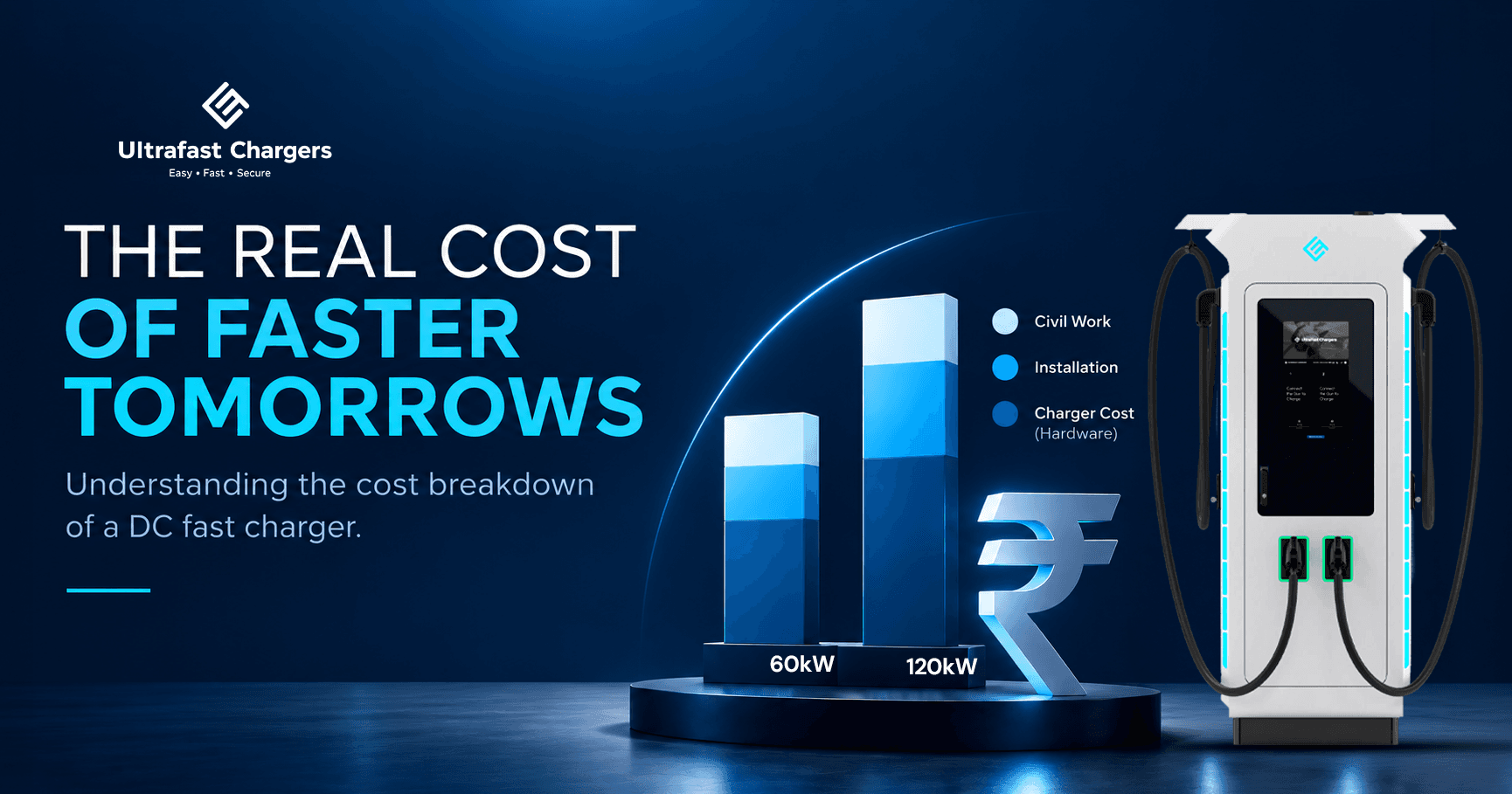
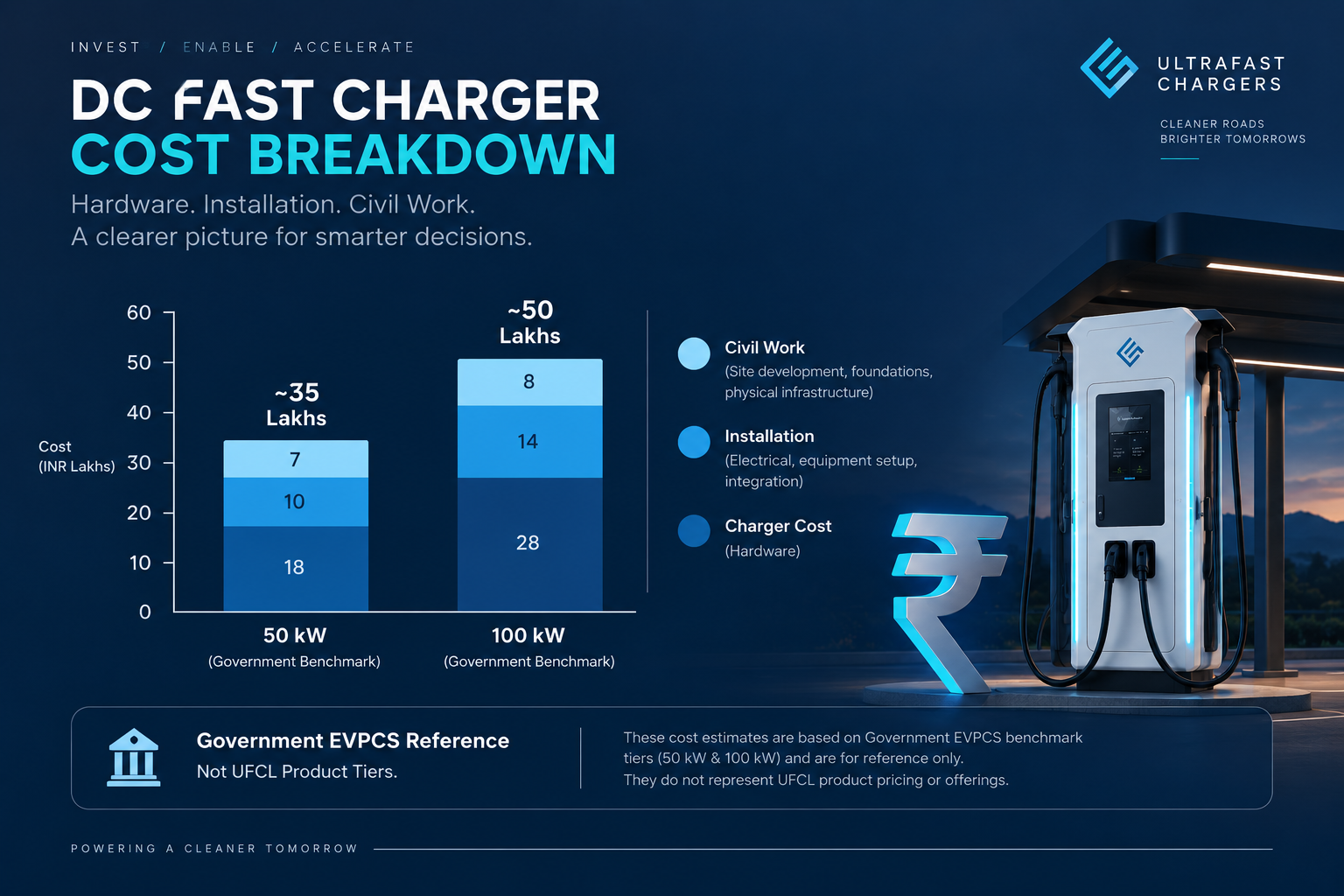
A DC fast charger's all-in cost (hardware plus site infrastructure) scales with power tier: UFCL's entry-level UFC 22 kW sits at the lower end given its simpler electrical needs, the UFC240 (60–240 kW) costs more as power is scaled up within that range, and the UFC400 (120–400 kW) commands the highest investment given its transformer and infrastructure demands. For an India-wide cost reference point, the government's own EVPCS benchmark table prices a 50 kW EVSE at ₹7.25 lakh and a 100 kW unit at ₹11.68 lakh (equipment only, before infrastructure) — useful for understanding how cost scales with power, even though it doesn't map directly onto any single vendor's product tiers. Contact UFCL for a quote against your specific power requirement.
Key Takeaways
- Total cost breaks into two buckets: the charger hardware (EVSE) and site infrastructure (the "balance of system"), which can rival or exceed hardware cost at higher power tiers.
- UFCL's own range spans three tiers — UFC 22 kW, UFC240 (60–240 kW), and UFC400 (120–400 kW) — and cost scales accordingly across them; exact pricing is quote-based given site-specific configuration.
- India's government EVPCS benchmark table (a separate, policy-driven cost reference, not tied to any single manufacturer's tiers) prices a 50 kW EVSE at ₹7.25 lakh and a 100 kW unit at ₹11.68 lakh, equipment only — useful for understanding how cost scales with power generally.
- Subsidy tiers (Category A–D under PM E-DRIVE) can offset 70–100% of costs depending on site type, though private commercial sites get partial support at best.
- Total cost of ownership (durability, uptime, replaceable parts) matters more than sticker price over a charger's 10-year expected lifespan.
Why "It Depends" Is the Honest Starting Point
Anyone quoting a single flat price for a DC fast charger is oversimplifying. The final number depends on power rating, site electrical readiness, civil work, and whether you're eligible for a government subsidy. But that doesn't mean the cost is unknowable — it breaks down into a handful of predictable line items.
The Two Big Cost Buckets
1. The Charger (EVSE) Itself
This is the hardware — the cabinet, power electronics, display, connectors, and software stack. Cost scales with power rating and features (dual-gun vs single, advertising display, boost mode).
2. Site Infrastructure ("Balance of System")
This is everything around the charger: the electrical connection (often requiring a dedicated transformer or upgraded supply for higher power units), cabling, civil foundation work, canopy/shelter, networking (SIM/Ethernet for OCPP connectivity), and commissioning.
For higher-power sites, infrastructure cost can rival or exceed the charger's own price — this is one of the most under-budgeted parts of a DC fast charging project.
What Government Benchmark Costs Tell Us (Important: Not UFCL's Product Tiers)
India's PM E-DRIVE scheme (via its EV Public Charging Stations component) publishes official benchmark costs at 50 kW and 100 kW, used to calculate subsidy amounts under that specific scheme. These are policy reference points, not UFCL's product lineup — UFCL's own range is built around 22 kW, 60–240 kW, and 120–400 kW tiers (see the next section). The government figures are still useful, though, because they show clearly how cost scales with power — a pattern that holds directionally across any manufacturer's range:
| Component | Capacity (Government Scheme Tier) | Government Benchmark Cost |
|---|---|---|
| Upstream infrastructure | Up to 50 kW | ₹6.04 lakh |
| Upstream infrastructure | Up to 100 kW | ₹14.80 lakh |
| Upstream infrastructure | Up to 150 kW | ₹19.00 lakh |
| Upstream infrastructure | Above 150 kW | ₹24.00 lakh |
| EVSE unit (CCS2) | 50 kW | ₹7.25 lakh |
| EVSE unit (CCS2) | 100 kW | ₹11.68 lakh |
Figures are the Ministry of Heavy Industries' published EVPCS benchmark costs at the scheme's own defined tiers (50 kW / 100 kW / 150 kW), used to calculate subsidy amounts — these tiers are a government policy construct, not any specific vendor's product range, and actual market pricing for private buyers varies by manufacturer, configuration and order volume.
Cost by UFCL's Actual Power Tier
Here's how cost drivers map onto UFCL's real product range — the tiers you'd actually be quoted against:
| UFCL Tier | Power Range | Typical Application | Where Cost Comes From |
|---|---|---|---|
| UFC 22 kW | 22 kW | Workplace, hotel, destination charging | Lowest-cost tier: simple 3-phase supply, wall-mount install, minimal civil work — directionally comparable to (though not identical to) the government's sub-50 kW cost band above |
| UFC240 | 60–240 kW (configurable) | Fleet depots, urban hubs | Mid-to-upper cost tier: higher-capacity electrical connection, dual-outlet dynamic load sharing, floor mounting — cost rises as the unit is configured toward the top of its range |
| UFC400 | 120–400 kW (configurable) | Highways, flagship CPO sites | Highest cost tier: larger transformer capacity, cable management (self-retracting arms), optional ad-display integration — well above the government's 100-150 kW reference band given the higher ceiling |
Because UFCL's tiers are configurable within a range (see Configurable DC Fast Chargers) and pricing depends on the specific power point you deploy at plus site conditions, exact cost is quote-based rather than a fixed list price — contact UFCL with your target power and site details for an accurate number.
Subsidy Categories That Can Offset Cost
Under PM E-DRIVE's EVPCS guidelines, subsidy percentage depends on where the charger is sited:
- Category A (government premises, hospitals, educational institutions with free public access): up to 100% of both infrastructure and equipment cost.
- Category B (railway stations, airports, metro stations, OMC outlets): 80% infrastructure / 70% equipment.
- Category C (malls, markets, highway commercial sites): 80% infrastructure, equipment not subsidised.
- Category D (battery-swapping stations): 80% infrastructure, equipment not subsidised.
Note: these subsidies route through government nodal agencies, not directly to individual businesses — see our companion article on the PM E-DRIVE scheme for the application pathway.
Total Cost of Ownership Matters More Than Sticker Price
A cheaper charger with poor thermal design, non-replaceable connectors, or weak after-sales support can cost more over 5–10 years through downtime, truck-roll repairs, and lost charging revenue. When comparing quotes, ask about:
- Expected product lifespan (UFCL's range is rated for a 10-year expected lifespan)
- Whether wear components (like gun contacts) are field-replaceable
- OTA update capability (avoids on-site technician visits for software issues)
- Local manufacturing and spare-parts availability
FAQs
Is a 400 kW charger always more expensive to run than a 60 kW one? Not necessarily per session — higher power means faster turnaround, so a busy highway site can generate more revenue per hour despite the higher upfront cost.
Does UFCL provide installation, or just the hardware? UFCL offers site survey, single-line drawing support, product recommendation, and commissioning as part of its deployment process — contact our team for a project-specific quote.
Can I get a subsidy for a private commercial site like a mall? Category C sites (malls, markets, highway commercial locations) can access 80% subsidy on infrastructure cost, though the equipment itself is not subsidised under current guidelines, and applications must go through an eligible nodal agency.
How much does it cost to charge an EV per session, not just install the charger? Running cost is separate from installation cost — it's largely the electricity tariff (per kWh) plus any operator session fee, and varies by state and network; DC fast charging tariffs are generally somewhat higher than home AC tariffs due to demand charges and infrastructure costs the operator must recover.
Is a 22 kW charger significantly cheaper than a 60 kW or higher unit? Yes — both hardware and infrastructure costs scale substantially with power rating; a 22 kW wall-mounted unit requires far simpler electrical infrastructure (often no dedicated transformer) than a 60 kW+ floor-mounted DC fast charger.
Does the cost of a DC fast charger include maintenance? Not typically — hardware/installation cost and ongoing maintenance/service cost are usually separate line items; ask any vendor for a clear breakdown of what's included in an initial quote versus what's billed as an annual maintenance contract.
How long does it take to recover the cost of a DC fast charger (payback period)? Payback depends entirely on utilisation, tariff structure, and any secondary revenue (ads, fleet contracts); given India's current low average public-charger utilisation (roughly 1–5%), payback periods vary enormously by site and shouldn't be assumed from hardware cost alone.
Are there hidden costs people often forget to budget for a DC charger installation? Commonly missed costs include the electrical connection/transformer upgrade, land lease or civil foundation work, networking (SIM/Ethernet for OCPP connectivity), signage, canopy/shelter, and ongoing annual maintenance — all separate from the charger's own price tag.
UFCL's Take
The right question isn't "what does a charger cost" but "what does a reliable, revenue-ready charging bay cost, all-in, over its working life." Request a quote for your site's power requirement and we'll walk you through the real numbers.