
DC Fast Charging Station Cost in India: Complete 2026 Guide
Why There Is No Single "DC Charger Price" in India
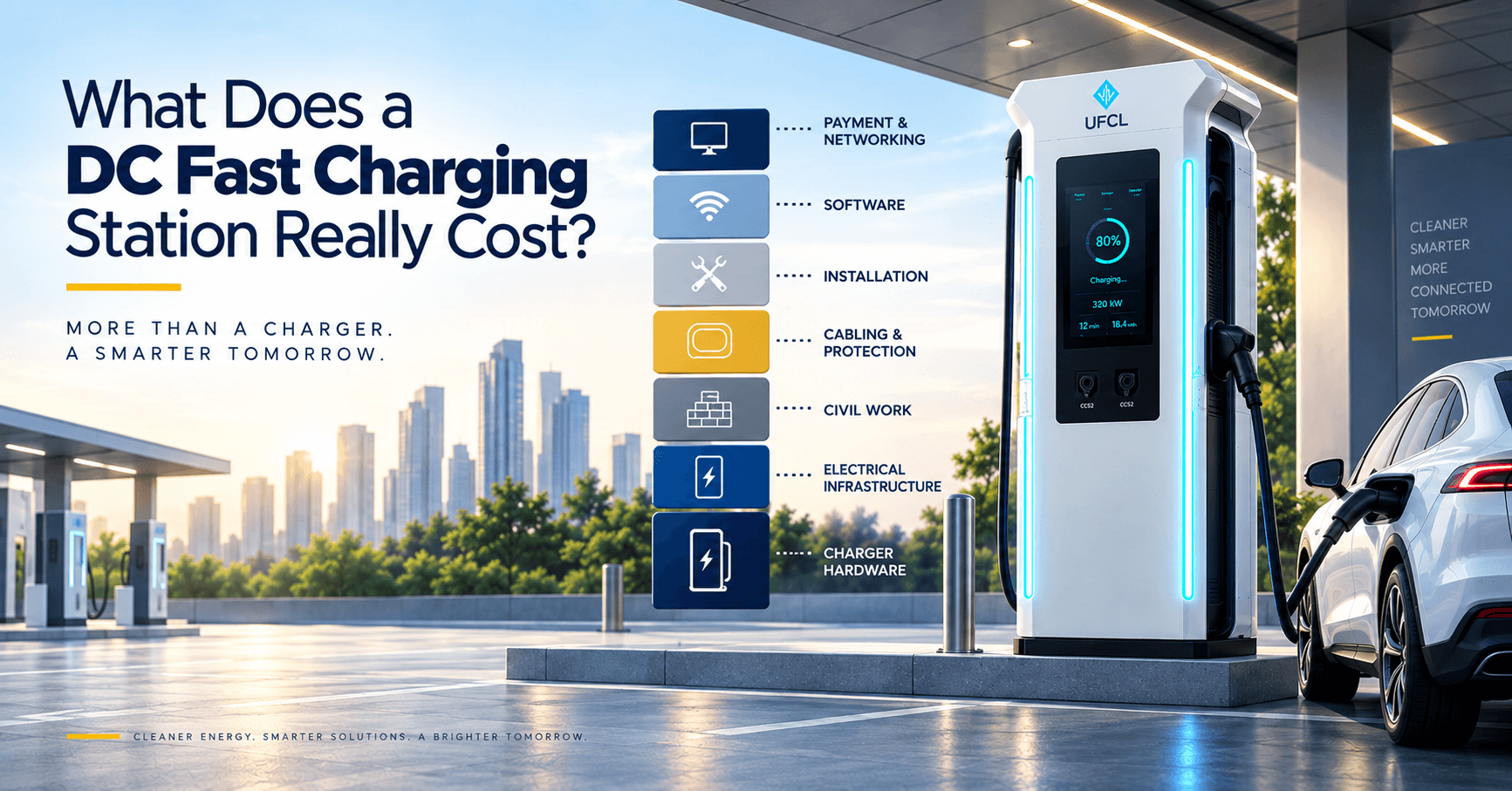
A DC fast charging station's total cost in India typically ranges from roughly ₹6–15 lakh for a compact 30–60 kW single-gun setup to ₹40–60 lakh or more for a high-power 240–400 kW multi-gun highway installation — but the charger hardware itself is only one part of that number, and site-specific electrical and civil work usually explains most of the variation. Anyone quoting a single flat number for "a DC charger" without specifying power level, connector count, site electrical readiness, and scope of installation is oversimplifying a genuinely variable project cost.
The ranges above are indicative, drawn from current published Indian market sources and installer guidance, and will not match every project. Treat this article as a framework for understanding what drives your own project's cost — not a quotation.
The Full Cost Stack: What Actually Goes Into a DC Fast Charging Station
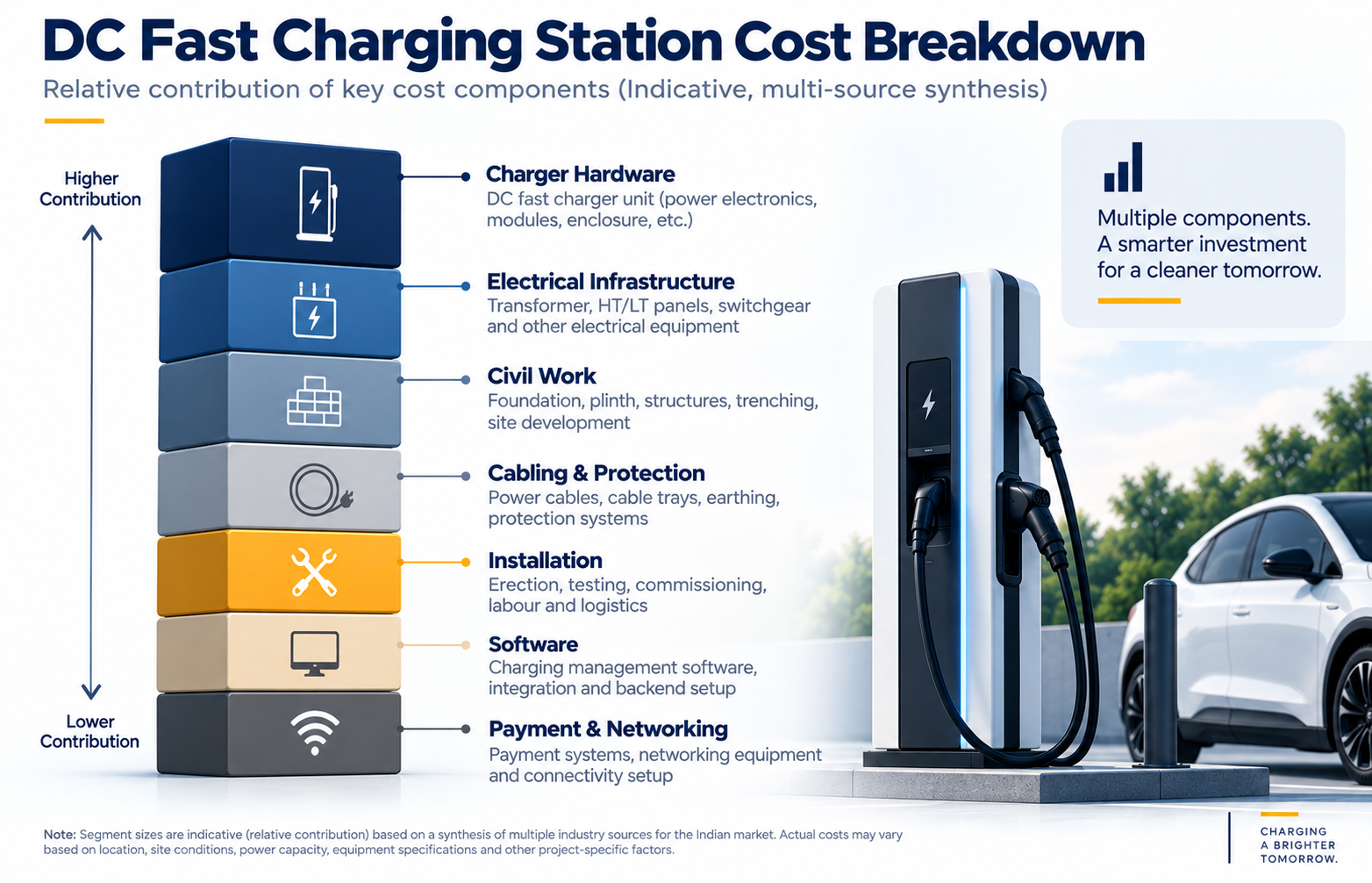
A realistic DC fast charging project budget includes far more than the charger cabinet:
| Cost Component | What It Covers |
|---|---|
| Charger hardware | The DC fast charger unit itself (22 kW, 60–240 kW, or 120–400 kW class) |
| Electrical infrastructure — sanctioned load & connection | DISCOM application, security deposits, new HT or LT connection sized for the charger's power draw |
| Transformer | A dedicated transformer, needed once site power requirements exceed existing connection capacity — a significant cost item for higher-power installations |
| Civil work | Foundation/plinth, shed or canopy, cable trenching, earthing pits, flooring, bollards and safety barriers |
| Cabling and protection equipment | Heavy-duty/armored cabling appropriate to the charger's current rating, LT panel, protection relays, earthing |
| Installation and commissioning | Licensed electrical contractor labor, testing, and commissioning by the charger vendor or an authorized partner |
| Software / CMS-CSMS | Charging management system for billing, remote monitoring, and OCPP-based backend integration — typically a per-charger monthly or annual subscription rather than a one-time cost |
| Payment system | UPI/card/app-based payment integration for public-facing sites |
| Networking / connectivity | GSM, Ethernet or Wi-Fi connectivity for remote monitoring and OTA management |
| Land / site costs | Where land is leased or purchased specifically for the station (highly location-dependent and outside a generic cost range) |
| Signage | Branding, wayfinding, and regulatory signage for public sites |
| AMC (Annual Maintenance Contract) | Ongoing preventive/corrective maintenance, typically an annual recurring cost after the warranty period |
Indicative Cost Ranges by Power Class
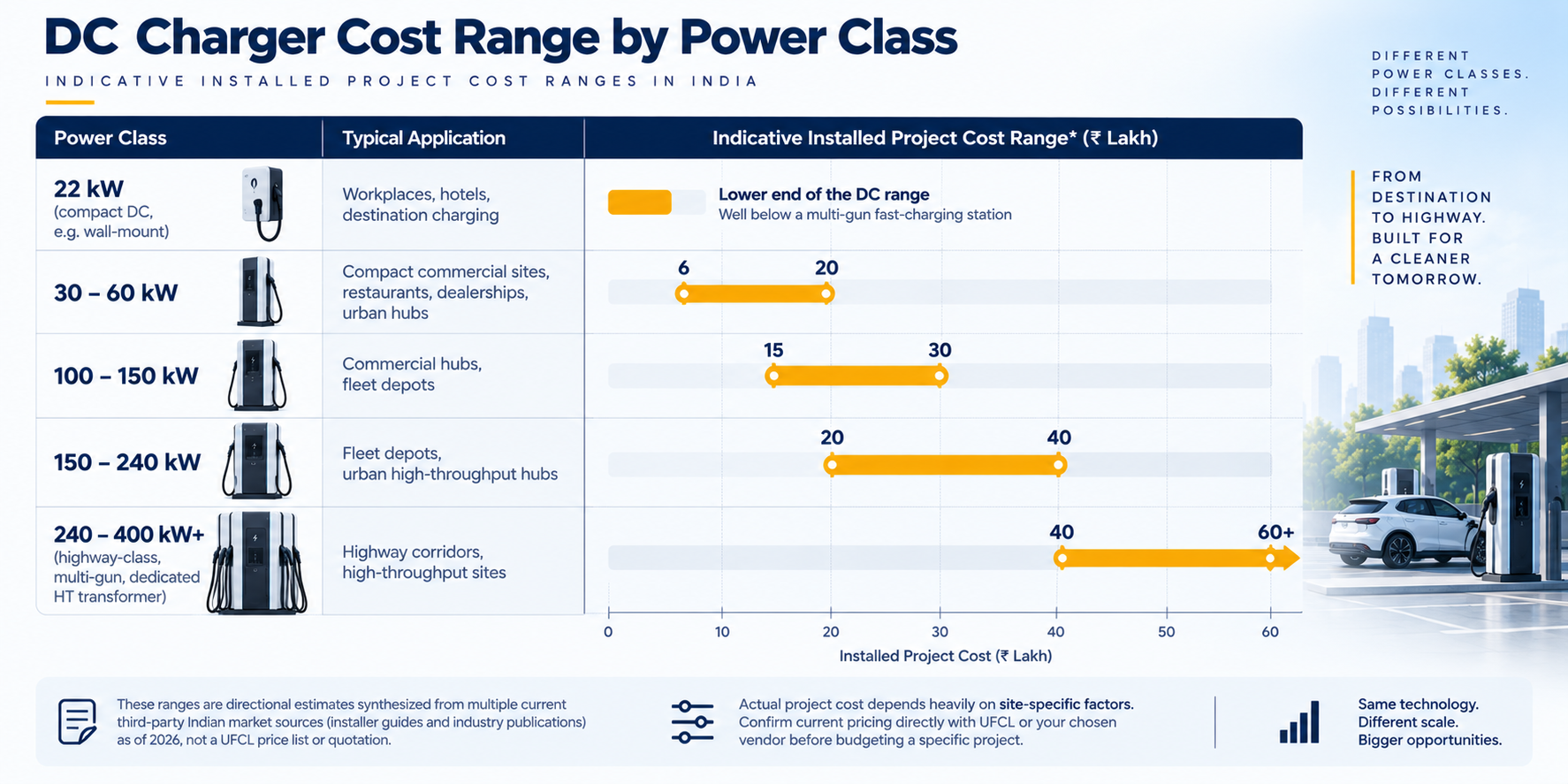
The table below synthesizes the general shape of ranges reported across multiple current Indian market sources for installed project cost (not hardware-only price), for planning purposes only.
| Power Class | Typical Application | Indicative Installed Project Cost Range* |
|---|---|---|
| 22 kW (compact DC, e.g. wall-mount) | Workplaces, hotels, destination charging | Lower end of the DC range — well below a multi-gun fast-charging station |
| 30–60 kW | Compact commercial sites, restaurants, dealerships, urban hubs | Roughly ₹6–20 lakh, depending on connector count and site readiness |
| 100–150 kW | Commercial hubs, fleet depots | Roughly ₹15–30 lakh |
| 150–240 kW | Fleet depots, urban high-throughput hubs | Roughly ₹20–40 lakh |
| 240–400 kW+ (highway-class, multi-gun, dedicated HT transformer) | Highway corridors, high-throughput sites | Roughly ₹40–60 lakh or more |
*These ranges are directional estimates synthesized from multiple current third-party Indian market sources (installer guides and industry publications, cited below) as of 2026, not a UFCL price list or quotation. Actual project cost depends heavily on the site-specific factors below. Confirm current pricing directly with UFCL or your chosen vendor before budgeting a specific project.
What Drives the Variation — Factor by Factor
- Charger power rating. Higher-power chargers (240 kW, 400 kW) need heavier cabling, larger protection equipment, and often a dedicated transformer — cost does not scale linearly with power.
- Number of connectors/guns. A dual-gun or multi-gun station costs more than a single-gun unit of the same total power class, but shares some civil and electrical infrastructure cost across guns.
- Existing electrical infrastructure. A site with an existing three-phase connection and adequate sanctioned load can save a substantial share of total project cost compared with a greenfield site needing a new HT connection and transformer.
- Transformer requirement. Whether a dedicated transformer is needed (and its rating) is one of the single largest cost swing factors, particularly above roughly 100–150 kW combined site demand.
- Civil work complexity. Site conditions — ground work, trenching distance, whether a canopy/shed is required — vary significantly and are highly location-specific.
- Location. Land cost, labor rates, and DISCOM charges vary by city and state; metro markets and states with higher land costs generally see higher civil-work costs than smaller cities, per multiple current installer sources.
- Connectivity and payment integration. A public-facing site needing app/UPI payment integration and remote monitoring adds cost beyond a captive fleet depot site that may not need public payment rails.
- Dynamic load sharing and smart features. Chargers supporting dynamic load sharing can improve utilization of a given electrical connection, which can offset — though not eliminate — the cost of a larger connection in multi-gun deployments.
- Government subsidy eligibility. Certain deployments — particularly government, public-sector, and specific public-access categories — may be eligible for central or state subsidy support that reduces the net cost to the site owner. See our guide on Government Subsidies for EV Charging Infrastructure in India 2026 for the current eligibility framework — verify the latest notification before making an investment decision.
Recurring / Operating Costs (Often Left Out of "Cost" Articles)
A cost guide that stops at installation misses a large share of the real economics:
- Energy costs — the electricity consumed, billed per kWh under the applicable commercial/EV charging tariff, which varies by state and DISCOM.
- Demand charges — many commercial/industrial electricity tariffs include a separate charge based on peak power drawn, which matters more for high-power DC fast charging than for typical commercial loads.
- AMC (Annual Maintenance Contract) — ongoing preventive and corrective maintenance after the initial warranty period.
- CMS/software subscription — typically billed per charger, per month or year.
- Connectivity costs — ongoing GSM/internet charges for remote monitoring.
- Utilization-dependent revenue — the economics of a DC fast charging station depend heavily on utilization rate (how much of its available capacity is actually used), which is the single biggest variable in payback time and is highly location- and use-case-specific.
A Worked Example Structure (Not a Fixed Quote)
Rather than presenting a single fabricated "typical project," here is the structure a genuine project budget should follow — fill in your own site's numbers:
- Charger hardware cost (by power class and connector count)
- + Electrical infrastructure (new connection, transformer if required)
- + Civil work (site-specific)
- + Cabling, protection, earthing
- + Installation and commissioning
- + Networking and payment systems (if public-facing)
- − Applicable subsidy support, if the site qualifies under a scheme such as PM E-DRIVE's EVPCS component (see Blog 7)
- = Net project cost
- ÷ Expected annual utilization and revenue per kWh → indicative payback period
How to Get an Accurate Quote
Because so much of total project cost is site-specific, the only reliable way to get an accurate number is a site survey — evaluating existing sanctioned load, available three-phase capacity, transformer requirements, site layout, and connectivity, before committing to a charger configuration. This is standard practice across the industry and is also how UFCL scopes its own deployments (see CTA below).
KEY TAKEAWAYS
- DC fast charging station cost in India is not a single number — it ranges roughly from single-digit lakhs (compact, single-gun, site-ready) to ₹40–60 lakh+ (high-power, multi-gun, greenfield electrical work).
- Charger hardware is typically a meaningful but not dominant share of total project cost; electrical infrastructure and civil work often drive the largest variation.
- A dedicated transformer requirement is one of the single biggest cost swing factors, especially above roughly 100–150 kW combined site demand.
- Recurring costs (energy, demand charges, AMC, software subscription) matter as much as upfront cost for real project economics.
- Subsidy eligibility (where applicable) can materially change net cost — but eligibility, category, and amount must be verified against current official guidelines, not assumed.
- A site survey, not a generic price list, is the only reliable way to get an accurate project cost.
FAQS
Q1. How much does a 60 kW DC fast charger cost in India? Published Indian market sources indicate an installed project cost roughly in the ₹6–20 lakh range for a 60 kW-class installation, depending on connector count and site electrical readiness — treat this as a directional estimate, not a quotation.
Q2. How much does a 240 kW DC fast charging station cost? Multi-gun, higher-power installations in the 150–240 kW range are indicatively reported in the roughly ₹20–40 lakh range in current Indian market sources, largely driven by electrical infrastructure and civil work requirements at that power level.
Q3. What is the biggest cost factor in a DC fast charging station? Beyond the charger hardware itself, whether a dedicated transformer and new HT/LT connection are required is typically the single largest cost-swing factor, alongside site-specific civil work.
Q4. Does DC fast charger cost include installation? Not by default — hardware price and installed project cost are different figures. A DC fast charger's hardware price is only one line item in the total project cost, which also includes electrical infrastructure, civil work, cabling, commissioning, software, and connectivity.
Q5. Are there ongoing costs after installation? Yes — energy costs, demand charges, AMC (annual maintenance), CMS/software subscription fees, and connectivity charges are all recurring costs beyond the initial project spend.
Q6. Can government subsidies reduce DC charging station cost in India? Certain categories of deployment — particularly government, public-sector, and specific public-access site categories — may be eligible for subsidy support under schemes such as PM E-DRIVE's EVPCS component. Eligibility and amounts vary; verify the latest notification before making an investment decision (see our subsidy guide).
Q7. Does dynamic load sharing reduce DC charging station cost? It can improve the effective utilization of a given electrical connection, which may reduce or delay the need for a larger, more expensive connection in multi-gun deployments — but it does not reduce hardware or civil-work cost directly.
Q8. How long does it take for a DC fast charging station to pay back its cost? Payback time depends primarily on utilization rate and local electricity tariffs/demand charges, which vary enormously by location and use case — there is no single reliable payback figure that applies across sites.
Q9. Is it cheaper to add a DC charger to a site that already has AC charging infrastructure? Generally yes, if the site already has adequate three-phase power and an existing DISCOM connection — the electrical and civil groundwork already in place can reduce the incremental cost compared with a greenfield DC installation.
Q10. What should I ask a vendor for an accurate DC charging station quote? Ask for a site survey covering existing sanctioned load, available three-phase capacity, transformer requirements (if any), civil work scope, and connectivity — a generic price list cannot substitute for site-specific evaluation.
CTA
Planning a DC fast charging deployment and need an accurate, site-specific cost estimate? Book a free site survey with UFCL — our team evaluates your electrical capacity, site layout, and charging requirement before recommending a configuration, so you get a real project cost, not a generic price list.