
Dynamic Load Sharing in EV Charging: How It Works (2026)
What Is Dynamic Load Sharing?
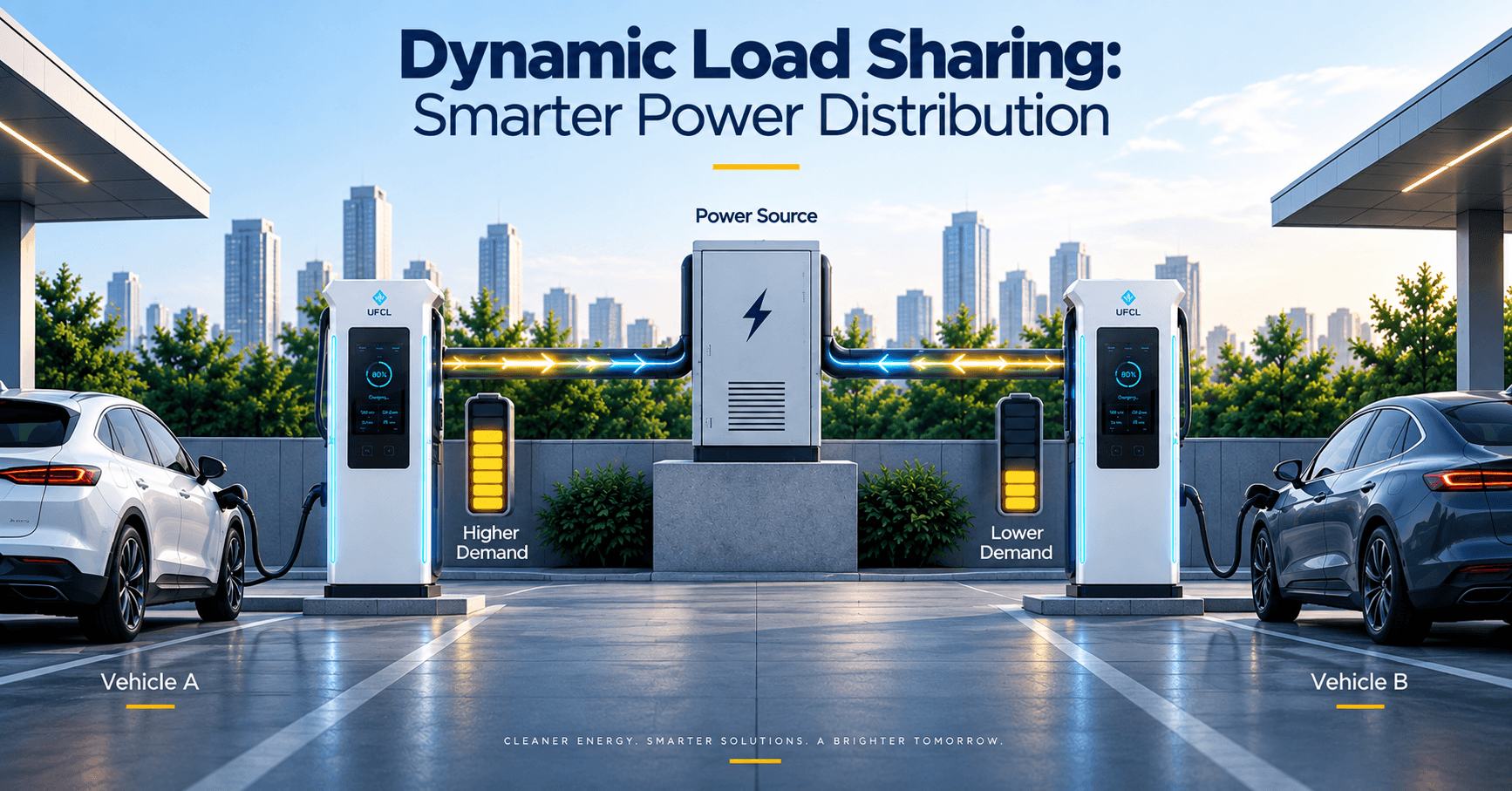
Dynamic load sharing is a load-management capability in DC fast charging that distributes available electrical power across multiple charging guns in real time, based on each connected vehicle's actual charging demand — rather than splitting power evenly or on a fixed schedule. Instead of assigning every gun the same fixed share of available capacity regardless of what each vehicle needs, the system continuously reallocates power so that a vehicle that can accept more current gets more, and a vehicle that's nearly full (and therefore accepting less current anyway) doesn't hold capacity hostage that another vehicle could be using.
Why Dynamic Load Sharing Is Needed: The Site Power Constraint Problem
Every charging site has a finite amount of electrical capacity available — determined by the sanctioned load from the utility, the site's transformer rating, and whatever other electrical loads (lighting, HVAC, equipment) share that same connection. Multi-gun DC fast charging stations, and multi-charger fleet depots, routinely need more instantaneous power than the site's total available capacity can support if every gun ran at its maximum rating simultaneously.
In India specifically, upgrading sanctioned load or transformer capacity is a real cost and lead-time item — new HT/LT connections and transformer upgrades involve utility approvals, civil work, and capital expense (see our DC Fast Charging Station Cost guide for a full breakdown). Dynamic load sharing is, in effect, a way to get more usable charging throughput out of the electrical capacity you already have, without necessarily paying for a bigger connection.
Static vs. Dynamic Load Management
| Static Load Management | Dynamic Load Sharing | |
|---|---|---|
| How power is split | Fixed, pre-set allocation per gun (e.g., always 50/50) | Reallocated continuously based on real-time demand |
| Utilization efficiency | Lower — unused capacity on one gun is not available to another | Higher — capacity is redirected to whichever vehicle can use it |
| Complexity | Simple to configure | Requires real-time communication between guns/power modules and a controller |
| Best suited for | Sites with predictable, low-conflict usage patterns | Multi-gun stations and multi-charger sites with variable, simultaneous demand |
How Dynamic Load Sharing Actually Works, Step by Step
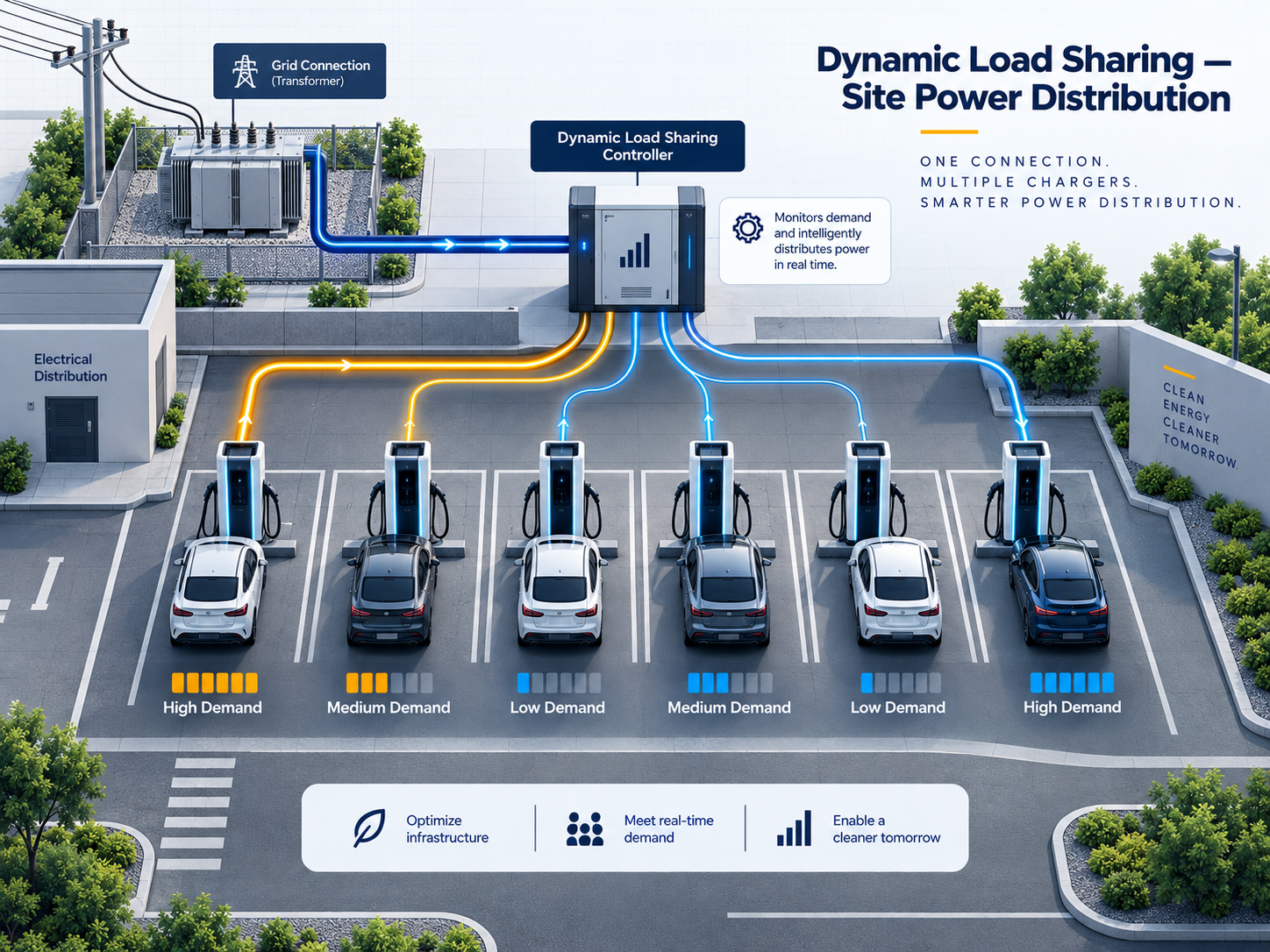
- Site power budget is defined — the total power available to the charging system is set (either fixed, or dynamically informed by a site energy management system where available).
- Each vehicle connects and negotiates — as a vehicle plugs in, its battery management system communicates its maximum acceptable charging current/power (this varies constantly through a charging session as state of charge changes).
- The load-sharing controller reads demand across all active sessions — it continuously monitors what every connected vehicle is actually requesting.
- Power is reallocated in real time — available capacity is redistributed toward vehicles requesting more, up to the site's total power budget, while vehicles that can't accept more (because they're nearly full, or their onboard limits cap them lower) simply aren't allocated capacity they can't use.
- Allocation continues to update through the session — as each vehicle's state of charge rises and its acceptance rate naturally tapers, the system continuously shifts freed-up capacity to other active sessions.
Worked Example
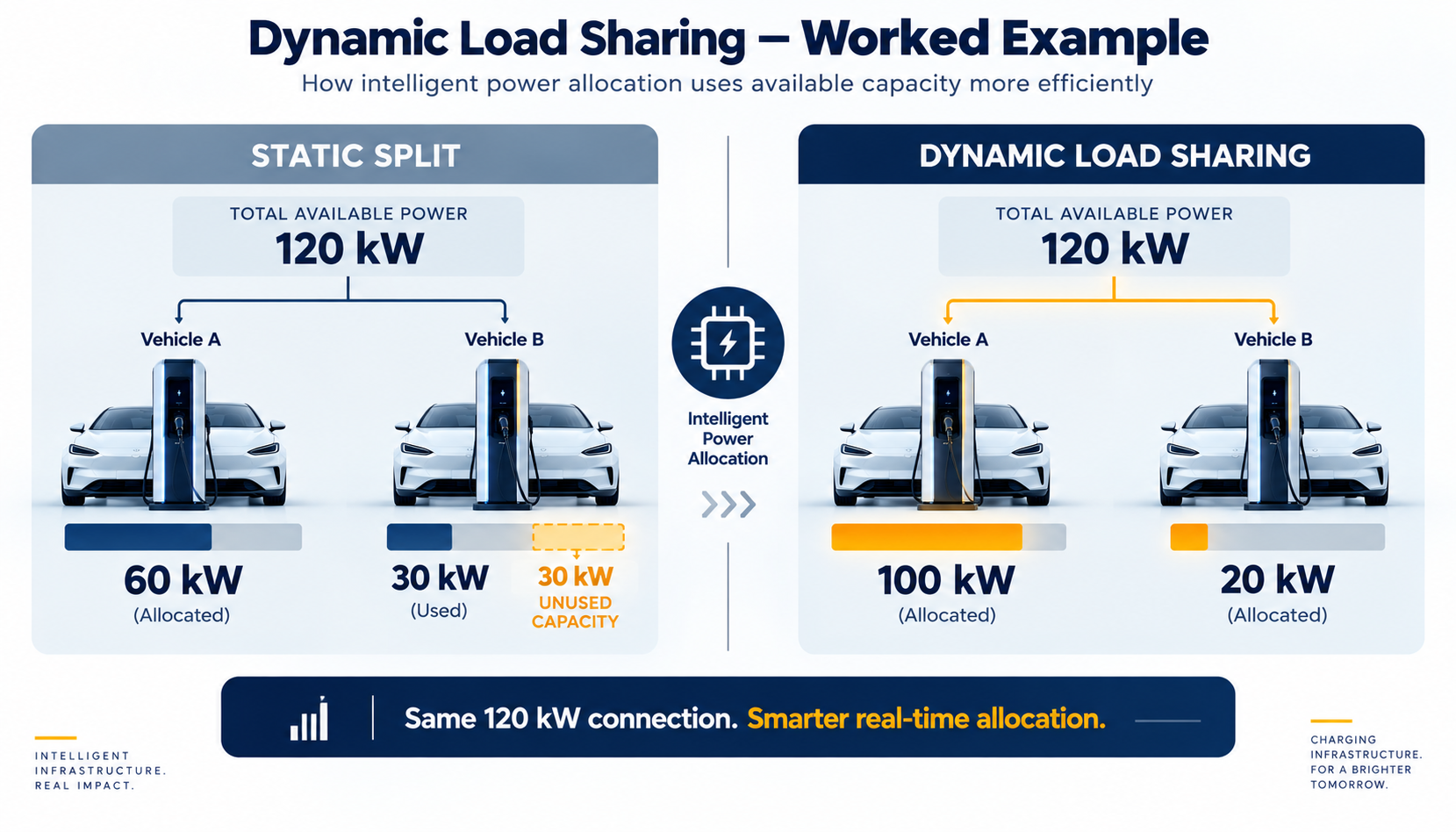
Consider a site with 120 kW of total available power split across two DC fast charging guns.
- Vehicle A arrives at 20% state of charge and can accept up to 100 kW.
- Vehicle B arrives at 70% state of charge and, because its battery is closer to full, its own battery management system limits it to accepting only 30 kW.
Under a static 50/50 split, each vehicle would be limited to 60 kW — Vehicle A would charge slower than it's capable of, and 30 kW of the site's available 120 kW would sit unused because Vehicle B can't accept its full allocated share.
Under dynamic load sharing, the system allocates 100 kW to Vehicle A (what it can actually use) and 30 kW to Vehicle B (its own limit) — using the full 120 kW of available site capacity efficiently, based on real demand rather than a fixed split.
(This example illustrates the general principle of dynamic load sharing and mirrors the mechanism UFCL describes for its UFC240 platform on its technology page — see Internal Links below for the product-specific reference.)
Fleet Depot Use Case
Fleet depots are the clearest case for dynamic load sharing: multiple vehicles typically plug in around the same shift-change windows, at varying states of charge, and depot electrical capacity is a fixed, often expensive-to-expand constraint. Dynamic load sharing lets a depot charge more vehicles to a usable state of charge within a fixed overnight or midday charging window than a static split would allow, directly affecting how many vehicles a depot's electrical infrastructure can practically support.
Commercial Building Use Case
In commercial and mixed-use buildings (offices, retail, hospitality), EV charging typically shares electrical capacity with the building's other loads, and demand is variable and hard to predict — some periods see many vehicles charging simultaneously, others see one or none. Dynamic load sharing lets the building's charging infrastructure use its allocated capacity efficiently across whatever mix of vehicles happens to be present, without needing to size the electrical connection for a worst-case scenario that's individually rare.
Highway Charging Use Case
At highway charging stations, where vehicle throughput and charging speed are the whole point, dynamic load sharing matters because different vehicles arrive at very different states of charge and battery sizes — some need a fast top-up, others a deeper charge. Efficient real-time allocation across multiple bays keeps overall site throughput high even when demand is uneven bay-to-bay, which is central to why UFCL's high-power UFC400 platform, aimed at highway corridors, supports this capability.
Charging Prioritization Strategies
Some systems layer prioritization rules on top of basic dynamic allocation — for example, prioritizing a vehicle close to a scheduled departure time, or reserving a minimum power floor for every active session so no vehicle is starved entirely while others take most of the available capacity. The specific prioritization logic available depends on the charger and CSMS platform in use; not every dynamic load sharing implementation includes advanced prioritization rules, so this should be confirmed against the specific hardware/software combination being deployed. [NEEDS UFCL CONFIRMATION: which specific prioritization rules, if any, are configurable on UFC240/UFC400 beyond baseline dynamic allocation.]
What to Check Before You Rely on It
- Confirm which UFCL (or any vendor's) products actually support dynamic load sharing — on UFCL's current range, this is a UFC240 and UFC400 capability, not a feature of the compact UFC 22 kW wall-mount unit (per UFCL's technology page).
- Confirm whether load sharing operates across guns on the same physical unit only, across multiple units at a site, or both — this varies by hardware architecture and should be checked against the specific product's documentation.
- Confirm the load sharing behavior with your specific CSMS/backend platform if remote monitoring and reporting on allocation decisions matters for your operations.
KEY TAKEAWAYS
- Dynamic load sharing reallocates available site power across chargers in real time based on actual vehicle demand, instead of splitting it evenly on a fixed basis.
- It exists to solve a real, common constraint: site electrical capacity (sanctioned load, transformer rating) is usually smaller than the theoretical peak demand of every connected gun running flat-out.
- Static load management is simpler but wastes capacity whenever one vehicle can't use its fixed allocation.
- The technique matters most for fleet depots, multi-gun commercial sites, and highway stations with simultaneous, variable demand.
- It is a power-management feature of specific hardware/firmware combinations — confirm it's actually supported on the specific charger model before assuming it.
FAQS
Q1. What is dynamic load sharing in EV charging? It's a real-time load-management method that distributes available electrical power across multiple charging guns based on each connected vehicle's actual demand, rather than a fixed, equal split.
Q2. How is dynamic load sharing different from static load management? Static load management assigns each charger a fixed share of power regardless of demand. Dynamic load sharing continuously reallocates power to wherever it can actually be used, improving overall site utilization.
Q3. Why do fleet depots need dynamic load sharing? Depots typically have multiple vehicles charging simultaneously at different states of charge, within a fixed, often costly-to-expand electrical capacity — dynamic allocation lets more vehicles charge usefully within that fixed capacity.
Q4. Does dynamic load sharing require special hardware? Yes — it requires chargers and controllers built to continuously monitor and reallocate power in real time; it is not available on every charger model (for example, it's a UFC240/UFC400-level capability on UFCL's range, not the compact 22 kW unit).
Q5. Can dynamic load sharing reduce electrical infrastructure costs? It can improve the effective usable capacity of a given electrical connection, potentially reducing or delaying the need for a larger sanctioned load or transformer upgrade — though it does not increase the actual physical capacity available.
Q6. Does dynamic load sharing work across multiple charging units, or just multiple guns on one unit? This depends on the specific hardware and site architecture — some systems manage allocation within a single unit's guns, others coordinate across multiple units at a site. Confirm this with the charger vendor for your specific deployment.
Q7. Is dynamic load sharing the same as smart charging under OCPP? They're related but not identical — OCPP's smart charging profiles are one mechanism through which schedules and limits can be communicated, but dynamic load sharing specifically refers to the real-time, demand-responsive reallocation of power across multiple simultaneous sessions.
Q8. Does dynamic load sharing slow down any individual vehicle? It can, if total demand across all connected vehicles exceeds the site's available capacity — but it ensures the available capacity is used as efficiently as possible across all vehicles rather than being wasted on vehicles that can't use their fixed share.
CTA
Planning a fleet depot or multi-bay charging site with limited electrical capacity? UFC240 and UFC400 both support dynamic load sharing — book a free site survey to evaluate how much charging throughput your existing electrical capacity can actually support.