
OCPP 1.6J vs OCPP 2.0.1: Key Differences & Which to Choose (2026)
What Is OCPP?
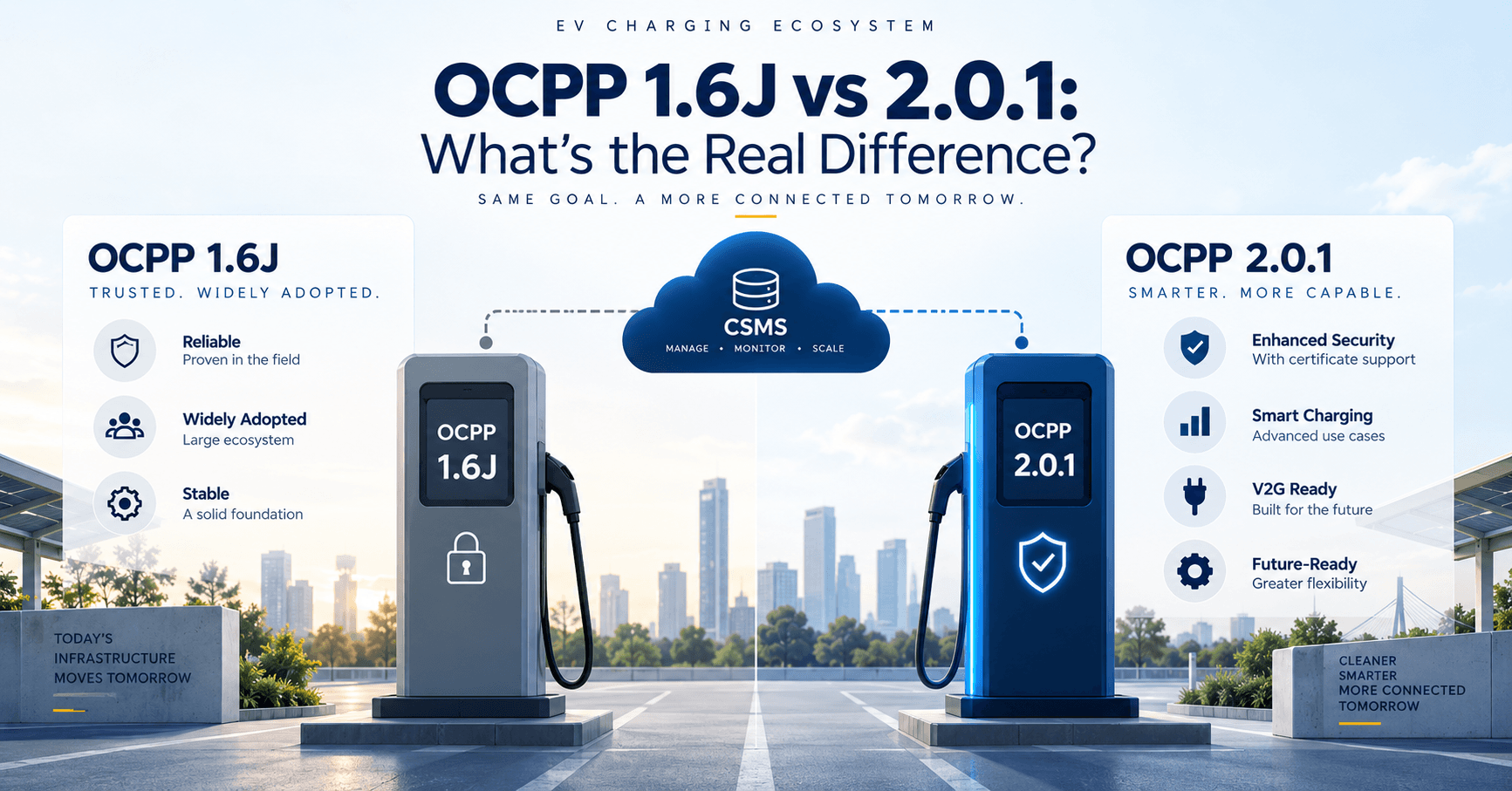
OCPP (Open Charge Point Protocol) is the open, vendor-neutral communication standard that lets a charging station talk to a backend charging station management system (CSMS). It was created by the Open Charge Alliance (OCA), the international non-profit consortium of charge point manufacturers, network operators, utilities and software vendors that governs the standard today.
Without a shared protocol, every charger manufacturer would need its own proprietary backend, and every network operator would be locked into whichever hardware vendor they started with. OCPP solves that by defining a common message format for things like starting and stopping a charging session, reporting meter values, sending firmware updates, and configuring a charger remotely — regardless of who built the charger or who built the software managing it.
Two versions dominate real-world deployments in 2026: OCPP 1.6 (in its JSON form, "1.6J") and OCPP 2.0.1. A third version, OCPP 2.1, is beginning to appear in newer deployments but is not yet the default choice for most new India projects, so this guide focuses on the comparison buyers are actually making today.
What Is OCPP 1.6J?
OCPP 1.6 was released by the Open Charge Alliance in 2015 and remains the most widely deployed version of the protocol worldwide. "1.6J" specifically refers to the JSON-over-WebSocket implementation of OCPP 1.6 (as opposed to the older SOAP-based transport), and JSON is effectively the default in current hardware — when people say "OCPP 1.6" today, they almost always mean 1.6J.
OCPP 1.6J covers the core functions most commercial charging deployments still rely on:
- Remote start/stop of charging sessions
- Real-time status notifications and meter values
- Basic smart charging via charging profiles (setting a maximum current/power limit on a schedule)
- RFID-based authentication
- Firmware update triggering
- Reservation of a charge point
- A security whitepaper extension (added later) that layers on basic TLS and certificate support for operators who choose to implement it
OCPP 1.6J is well understood, broadly supported across CSMS platforms, and remains "adequate for existing installations with no near-term plans for V2G or grid integration" — but it was not designed from the ground up with today's security and smart-grid requirements in mind, which is where 2.0.1 comes in.
What Is OCPP 2.0.1?
OCPP 2.0.1 is the current-generation OCPP standard, released by the Open Charge Alliance in 2020, built around a formal device management model, mandatory-by-design security (TLS and certificate-based authentication), advanced smart charging, and native support for ISO 15118 Plug & Charge. In 2024, OCPP 2.0.1 (edition 3) was approved as the international standard IEC 63584 — a signal that it is increasingly treated as the reference protocol in tenders and utility requirements, not just an OCA-internal spec.
OCPP 2.0.1 organizes a charging station's capabilities into a structured "device management model" of components and variables, which a CSMS can query and configure generically — rather than relying on the more ad-hoc configuration key/value approach in 1.6. This is what unlocks more granular monitoring, remote diagnostics, and consistent multi-vendor management at scale.
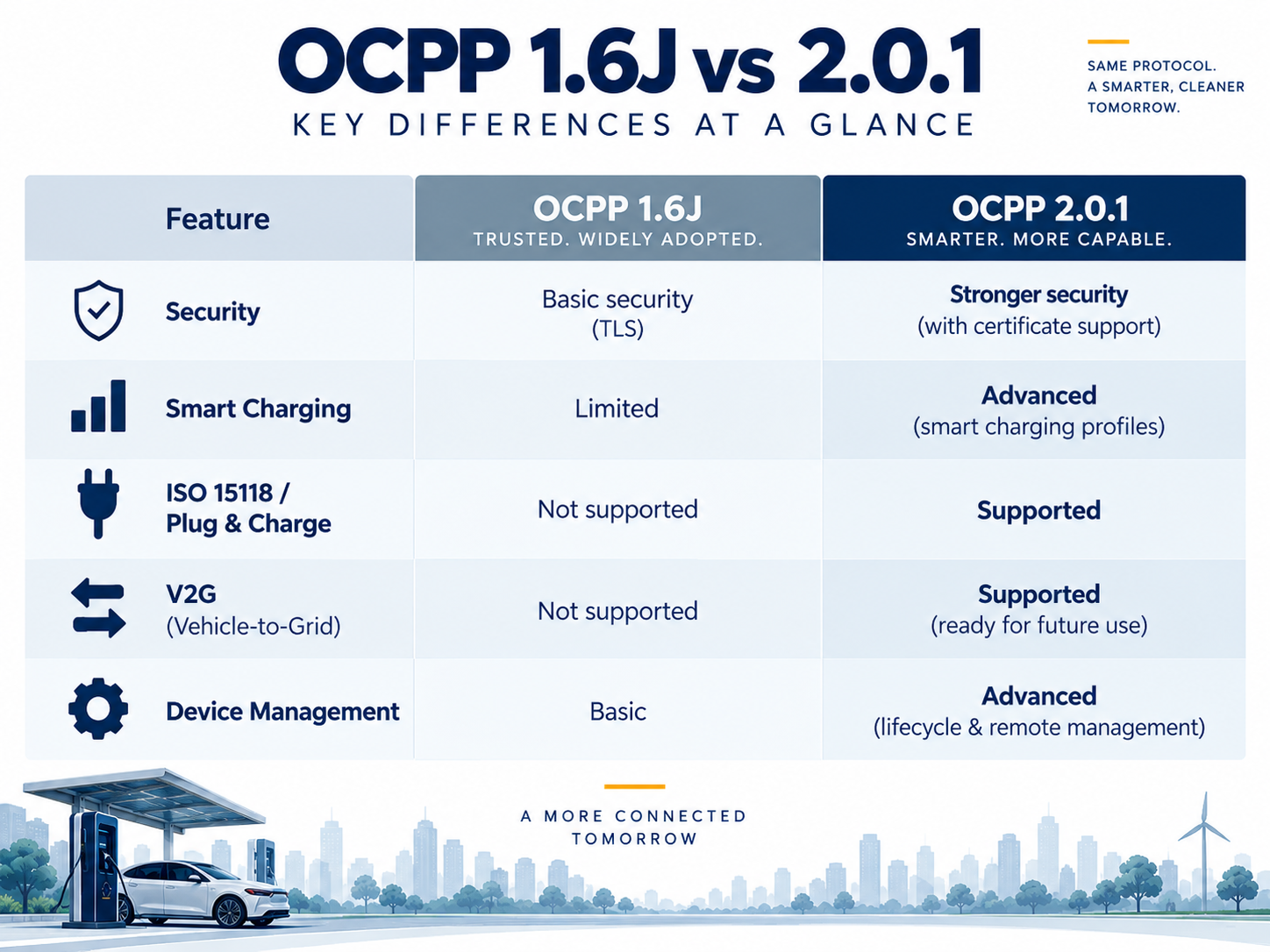
OCPP 1.6J vs OCPP 2.0.1 — Comparison Table
| Capability | OCPP 1.6J | OCPP 2.0.1 |
|---|---|---|
| First released | 2015 | 2020 (IEC 63584 in 2024) |
| Transport | WebSocket + JSON | WebSocket + JSON |
| Security model | Optional add-on (Security Whitepaper extension for TLS/certificates) | Built into the core spec — TLS and certificate-based authentication by design |
| Device management | Configuration key/value pairs | Structured component/variable device management model |
| Smart charging | Basic charging profiles (schedule-based power/current limits) | Advanced, more granular smart charging profiles for grid-responsive load management |
| ISO 15118 / Plug & Charge | Not natively supported | Native support for Plug & Charge and Autocharge |
| V2G (bidirectional charging) readiness | Not supported | Framework support for V2G-related messaging |
| Transaction handling | Session-based, less granular | Improved, more structured multi-session/multi-connector transaction handling |
| Firmware management | Supported (remote trigger) | Supported, integrated into the device management model |
| Interoperability with the other version | Not compatible with 2.0.1 | Not compatible with 1.6 |
| Current real-world adoption (2026) | Majority of currently deployed hardware and CSMS platforms | Growing share; the default recommendation for new deployments |
| Best suited for | Existing fleets/sites with no near-term V2G or advanced grid-integration plans | New deployments, especially those needing stronger security, Plug & Charge, or future V2G |
Security: The Biggest Practical Difference
Security is the area where the two versions diverge most in practice. OCPP 1.6J can support TLS and certificates through the optional Security Whitepaper extension, but it is bolted on, and not every 1.6J deployment implements it. OCPP 2.0.1 builds TLS encryption and certificate-based device authentication into the core protocol, which matters more every year as charging networks become larger, more connected, and more attractive as attack surfaces (a charger is, after all, an internet-connected device with a payment and grid-adjacent function).
For any deployment serving government fleets, regulated utilities, or enterprise buyers with a security compliance requirement, OCPP 2.0.1's security-by-design model is increasingly treated as the baseline expectation rather than a nice-to-have.
Smart Charging and Device Management
Both versions support "smart charging" in the sense of setting time-based power limits, but OCPP 2.0.1's profiles are more granular and better suited to genuinely dynamic, grid-responsive charging — the kind needed as more sites deal with demand charges, time-of-use tariffs, or shared electrical capacity across many chargers (see our companion guide on Dynamic Load Sharing for how this plays out at the site level).
OCPP 2.0.1's device management model also gives a CSMS a consistent way to read and set configuration across a mixed fleet of chargers, which reduces the vendor-specific quirks that make multi-brand OCPP 1.6J deployments harder to manage centrally.
Transactions, Diagnostics and Firmware
OCPP 2.0.1 improves multi-session and multi-connector transaction handling — relevant for chargers with two or more guns running independent sessions — and integrates firmware and diagnostics reporting into the same structured device model used for everything else. OCPP 1.6J supports firmware updates and diagnostics too, but through separate, less unified message flows.
ISO 15118 and OCPP 2.0.1: Related but Different Layers
It's worth being precise here, because the two are often conflated. ISO 15118 governs the communication between the vehicle and the charger (including Plug & Charge authentication). OCPP governs the communication between the charger and the backend CSMS. OCPP 2.0.1 is the version that natively carries ISO 15118 Plug & Charge data through to the backend — but ISO 15118 itself is a separate standard, developed and maintained independently. For the full picture of how vehicle-to-charger authentication works, see our dedicated guide: ISO 15118 and Plug & Charge Explained.
Interoperability and Backward Compatibility: What People Get Wrong
A common misconception is that a charger or CSMS running OCPP 2.0.1 will simply "still work" with a 1.6J counterpart, or vice versa. It will not. OCPP 1.6 and OCPP 2.0.1 are separate, non-interoperable protocol versions — a charging station configured for one cannot communicate directly with a backend expecting the other. Some CSMS platforms support both versions and can talk to different chargers on each, but that is a platform capability, not a property of the protocol itself.
This also means: choosing OCPP 2.0.1 does not automatically make a charger compatible with every vehicle or every feature. Vehicle-side ISO 15118 support, CSMS-side feature support, and charger firmware all have to line up independently. OCPP 2.0.1 is a necessary enabler for things like Plug & Charge — it is not a guarantee that they will work end-to-end without the other pieces in place.
Migration Considerations
If you're running an existing OCPP 1.6J fleet, migrating to 2.0.1 is not typically a simple firmware flag — it usually means:
- Confirming your CSMS/backend platform supports OCPP 2.0.1 (many platforms run both versions in parallel rather than requiring an all-or-nothing switch)
- Verifying charger hardware and firmware support the new protocol (not all 1.6J-era hardware can be upgraded in the field)
- Planning a phased rollout rather than a single cutover, particularly across a large, geographically distributed fleet
- Re-testing RFID, payment, and any custom integrations built against 1.6J message formats
For most operators, the practical path is: keep existing 1.6J assets running as-is, and specify 2.0.1 for new hardware going forward, rather than attempting a disruptive mid-life protocol swap.
Which Businesses Should Choose Which Version? A Decision Framework
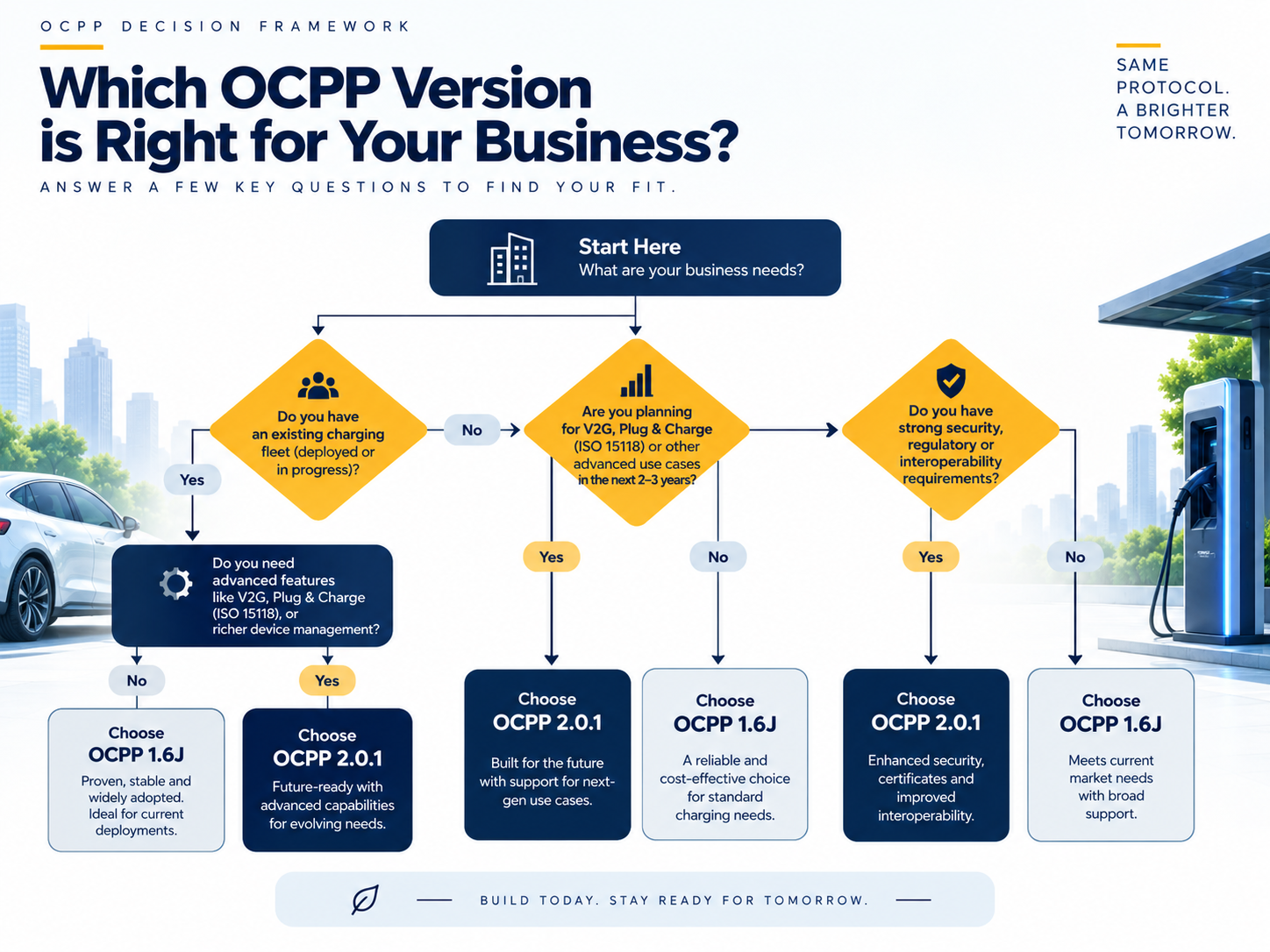
| Situation | Recommended starting point |
|---|---|
| Existing fleet/site running 1.6J with no near-term V2G, Plug & Charge, or heightened security requirement | Continue on OCPP 1.6J; plan a migration path for future hardware |
| New deployment, standard commercial or fleet site, no immediate V2G plan | OCPP 2.0.1 — treat it as the sensible minimum for new hardware in 2026 |
| Government, utility, or enterprise deployment with a security/compliance mandate | OCPP 2.0.1 — the built-in TLS/certificate model is close to a baseline requirement now |
| Roadmap includes Plug & Charge, V2G, or demand-response/DER participation | OCPP 2.0.1 (with an eye on OCPP 2.1 as that version matures) |
| Mixed fleet across multiple hardware vendors and ages | Confirm your CSMS supports both versions concurrently rather than forcing uniformity |
KEY TAKEAWAYS
- OCPP is the open protocol connecting a charging station to its backend management system (CSMS) — it does not govern vehicle-to-charger communication (that's ISO 15118).
- OCPP 1.6J (2015) remains the most widely deployed version; OCPP 2.0.1 (2020, IEC 63584 in 2024) is the current-generation, security-first standard.
- OCPP 2.0.1's core advantages are built-in TLS/certificate security, a structured device management model, more advanced smart charging, and native Plug & Charge support.
- OCPP 1.6 and 2.0.1 are not interoperable — this is a protocol-level fact, not a configuration choice.
- OCPP 2.0.1 does not, by itself, guarantee Plug & Charge or full vehicle compatibility — vehicle, charger, and CSMS support must all align.
- For new deployments in 2026, OCPP 2.0.1 is broadly the sensible default; existing 1.6J fleets can generally stay on 1.6J and migrate hardware over time rather than forcing a disruptive cutover.
FAQS
Q1. What is the main difference between OCPP 1.6J and OCPP 2.0.1? OCPP 2.0.1 adds built-in TLS/certificate-based security, a structured device management model, more advanced smart charging, and native ISO 15118 Plug & Charge support. OCPP 1.6J covers core session management and basic smart charging but relies on an optional extension for stronger security.
Q2. Is OCPP 2.0.1 backward compatible with OCPP 1.6? No. OCPP 1.6 and OCPP 2.0.1 are not interoperable protocol versions. A CSMS platform can support both versions for different chargers, but a single connection runs one version or the other.
Q3. Which OCPP version supports Plug and Charge? OCPP 2.0.1 natively carries ISO 15118 Plug & Charge data to the backend. OCPP 1.6J does not natively support this.
Q4. Do I need to upgrade my existing OCPP 1.6J chargers to 2.0.1? Not necessarily. If there's no near-term need for V2G, Plug & Charge, or a stricter security mandate, 1.6J remains functional for existing sites. Most operators specify 2.0.1 for new hardware rather than retrofitting older assets.
Q5. Does OCPP 2.0.1 make a charger compatible with every EV? No. Vehicle compatibility depends on the vehicle's own ISO 15118 support and the CSMS's feature support, not the charger's OCPP version alone.
Q6. What is OCPP 1.6J specifically, as opposed to OCPP 1.6? "1.6J" refers to the JSON-over-WebSocket transport implementation of OCPP 1.6, as distinct from the older SOAP-based transport. In practice, "OCPP 1.6" today almost always means 1.6J.
Q7. Is OCPP 2.0.1 an official international standard? OCPP 2.0.1 edition 3 was approved as IEC 63584 in 2024, which supports its growing use as a reference requirement in tenders and utility specifications.
Q8. What comes after OCPP 2.0.1? OCPP 2.1 is the next version and is beginning to appear in newer deployments, building on 2.0.1 with additional smart charging, V2G, and DER-related capability. It is not yet the default choice for most new India deployments as of 2026.
Q9. Can a charger run both OCPP 1.6J and 2.0.1? Some hardware can support both, selectable via firmware/configuration, but it connects to a backend using one version per session — it does not run both simultaneously on the same connection.
Q10. Why does OCPP matter for fleet or CPO buyers specifically? OCPP is what prevents vendor lock-in: it lets you change or add hardware vendors without rebuilding your backend, and lets you switch or add CSMS software without replacing chargers already in the field.
CTA
Planning new charging infrastructure and deciding between OCPP versions? UFC240 and UFC400 DC fast chargers support both OCPP 1.6J and OCPP 2.0.1 — talk to UFCL's engineering team about the right protocol and hardware configuration for your deployment.