
EV Charging: The Complete Guide - Types, Speeds, Costs & Standards
What Is EV Charging? The Complete Guide (2026)
EV charging is the process of transferring electricity from a power source into an electric vehicle's battery, using either AC (Alternating Current, converted to DC inside the car) or DC (Direct Current, converted inside the charger itself). AC charging is slower (3–22 kW, hours) and typical for homes and workplaces; DC fast charging is faster (22–400 kW, minutes) and typical for highways, fleets and commercial sites.
Key Takeaways
- EV charging always involves three components: a power source, a charger (EVSE), and the vehicle's battery management system (BMS).
- AC charging converts power inside the car (slow, 3–22 kW). DC charging converts power inside the charger (fast, 22–400 kW).
- India's standard fast-charging connector for four-wheelers is CCS2.
- Charging speed always tapers as a battery approaches full — the BMS, not the charger, sets the real limit.
- UFCL manufactures DC fast chargers from 22 kW to 400 kW for exactly the "fast charging" end of this spectrum.
What Does "EV Charging" Actually Mean?
EV charging is the process of transferring electrical energy from a power source into an electric vehicle's battery so it can drive. It sounds like plugging in a phone, and at the simplest level, it is — but the equipment, power levels, and speed involved vary enormously depending on the type of charger used and where you're charging.
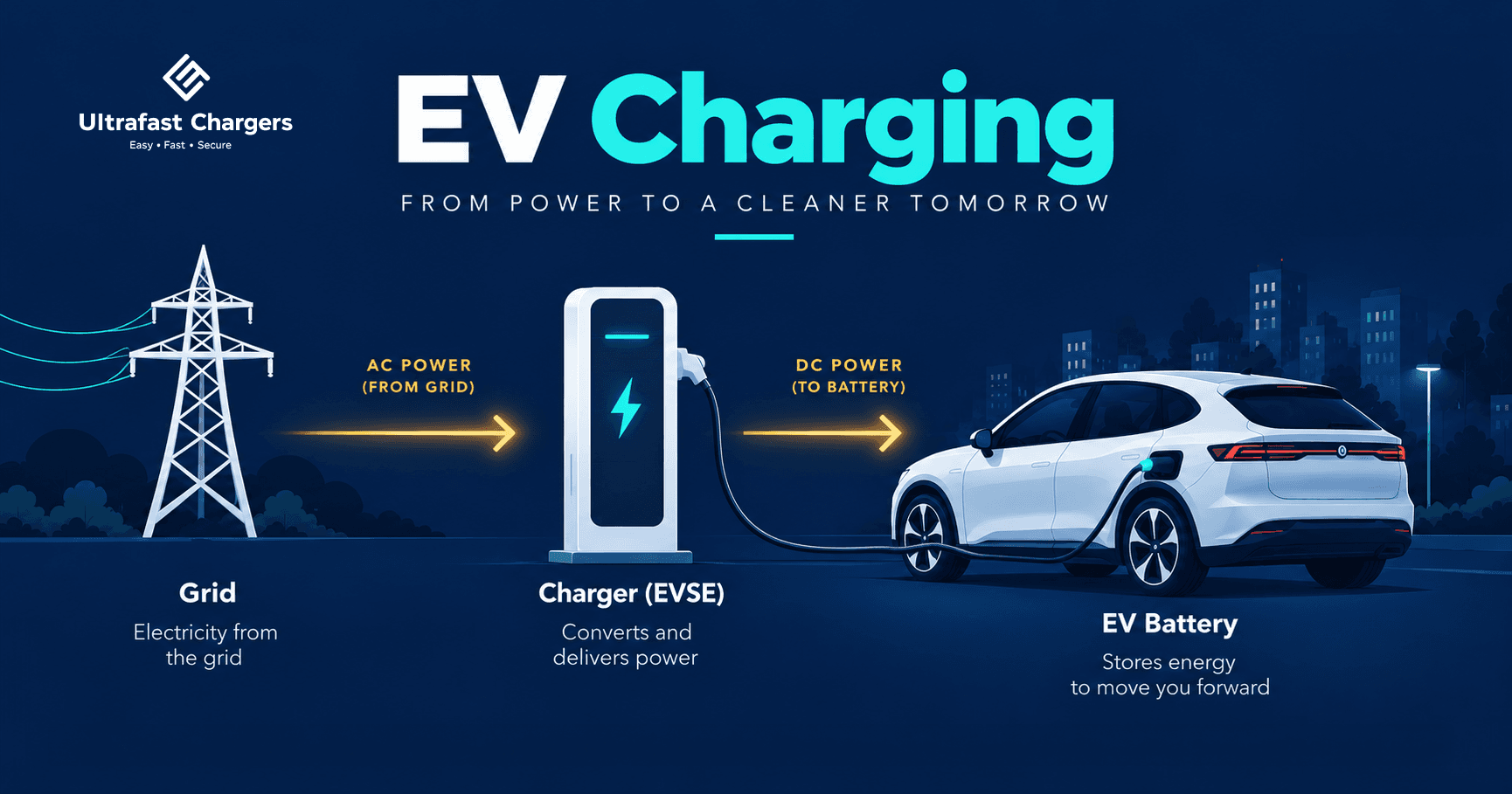
Every EV charging session involves three things: a power source (the electricity grid), a charging device (called EVSE — Electric Vehicle Supply Equipment), and the vehicle's battery management system (BMS), which decides how much current the battery can safely accept at any given moment.
AC Charging vs DC Charging: The Core Difference
This is the single most important concept in EV charging.
- AC (Alternating Current) charging delivers AC power to the vehicle, and the car's onboard converter changes it to DC before it reaches the battery. Home chargers and most workplace/destination chargers are AC. Because the car's small onboard converter is the bottleneck, AC charging is slower — typically 3 kW to 22 kW.
- DC (Direct Current) charging converts AC to DC inside the charger itself, before it reaches the car, and feeds DC power straight to the battery — bypassing the car's onboard converter entirely. This is why DC chargers can push far more power, from 22 kW compact units up to 400 kW highway-grade systems, and charge a compatible EV in minutes rather than hours.
| AC Charging | DC Fast Charging | |
|---|---|---|
| Typical power | 3–22 kW | 22–400 kW |
| Typical charge time (10–80%) | 4–10 hours | 15 minutes–1 hour |
| Where you'll find it | Homes, apartments, workplaces | Highways, fleet depots, malls, fuel stations |
| Conversion happens in | The car | The charger |
check the complete information
The Charging "Levels" You'll Hear About
Globally, EV charging is often grouped into levels:
- Level 1 — Standard household socket (~2.3 kW). Very slow; mostly a backup option.
- Level 2 — Dedicated AC wallbox (3.3–22 kW). Common for home and overnight charging.
- Level 3 / DC Fast Charging — 22 kW and above, delivered as direct current. This is where UFCL's product range — the UFC 22 kW, UFC240 (60–240 kW) and UFC400 (120–400 kW) — sits, built for businesses that need vehicles charged fast, not overnight.
How a DC Fast Charging Session Actually Works
- The driver plugs in using a CCS2 connector (India's standard for DC fast charging).
- The charger and vehicle "handshake" over a communication protocol (commonly OCPP on the backend, and ISO 15118 or CHAdeMO/CCS-specific communication with the car) to confirm voltage, current limits and safety parameters.
- The car's BMS requests power in real time, and the charger delivers current along a curve that starts high and gradually tapers as the battery fills — this is why the last 20% always takes longer than the first 20%.
- The session ends automatically once the target state of charge is reached or the driver stops it.
Why This Matters for Businesses, Not Just Drivers
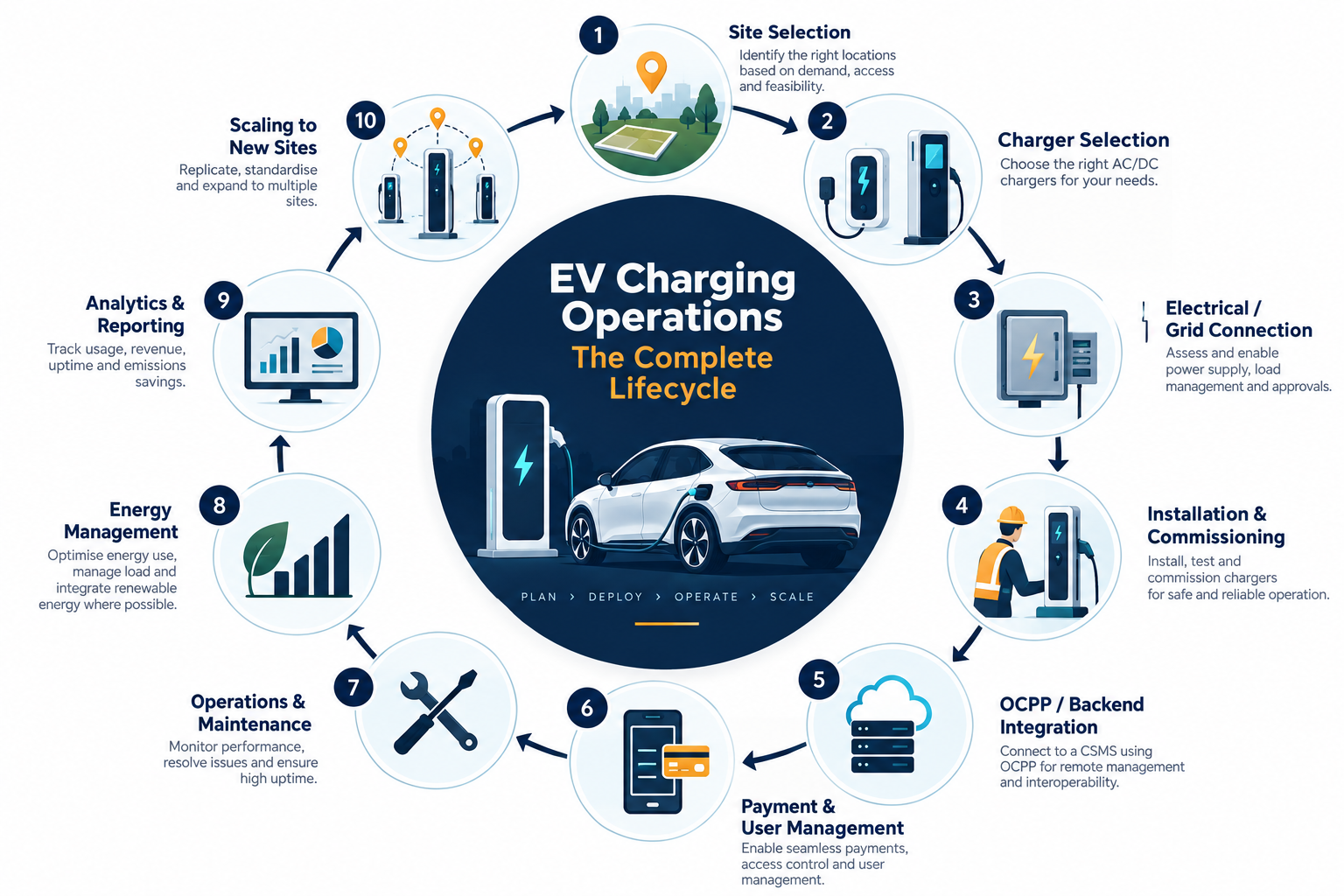
For an individual EV owner, "what is EV charging" is mostly a driving-convenience question. For a business — a fleet operator, a mall, a highway rest stop, a charge point operator — it's an infrastructure decision: which power level, which standards, and which hardware can keep vehicles moving without downtime. That's the layer UFCL operates in, designing ARAI-certified DC fast chargers from 22 kW to 400 kW for exactly these commercial, high-utilisation applications.
Two technical concepts sit behind almost every modern EV charging deployment worth knowing at a glance: OCPP, the open protocol that lets a charger talk to a backend management platform (see our full guide, What Is OCPP?), and dynamic load sharing, which intelligently splits available power between multiple vehicles charging at once rather than dividing it evenly (see What Is Dynamic Load Sharing?). Both are explored in depth elsewhere in this guide's topic cluster.
FAQs
Is EV charging the same as a petrol fill-up? Functionally, yes — both refuel a vehicle. But charging speed depends on power level, battery chemistry and the vehicle's own charging curve, so it isn't a fixed "X minutes" answer the way a fuel fill-up is.
Can any EV use any charger? Only if the connector and voltage/communication standard match. In India, CCS2 is the standard connector for DC fast charging on most four-wheelers.
Is DC charging safe for daily use? Yes, when the hardware is certified and the vehicle's BMS manages the session. See our companion blog, "Is DC Charging Bad for Your EV Battery?", for a deeper look at battery health.
How long does it take to charge an EV? It depends entirely on the charger's power level and the vehicle's own maximum acceptance rate: roughly 4–10 hours on a home AC charger, 1–2 hours on an entry-level 22 kW DC charger, and 15–45 minutes on a 60–400 kW DC fast charger for a meaningful top-up (typically 10–80% state of charge).
What is EVSE? EVSE stands for Electric Vehicle Supply Equipment — the technical term for what most people simply call "the charger." It covers the physical hardware that safely delivers power from the grid to the vehicle, including the cabinet, connector, and communication electronics.
Do I need a special connector for EV charging in India? For DC fast charging, yes — CCS2 is India's standard connector for most four-wheelers. Two- and three-wheelers typically use different, lower-power standards such as Bharat AC-001.
Can I charge an EV using a regular electrical socket? Technically yes, using a Level 1 charging cable at very low power (~2.3 kW), but this is extremely slow and generally only recommended as an occasional backup, not a primary charging method.
What's the difference between a "charger" and a "charging station"? In casual use the terms are interchangeable. Technically, a charging station (or site) can house multiple individual chargers (EVSE units), each capable of serving one or more vehicles depending on the number of outlets/guns.
UFCL's Take
Understanding EV charging is step one. Choosing the right charger for your site, vehicles and business model is step two — and that's where UFCL's 22 kW to 400 kW DC fast charging range comes in. Explore our EV chargers or talk to our team about your site.